
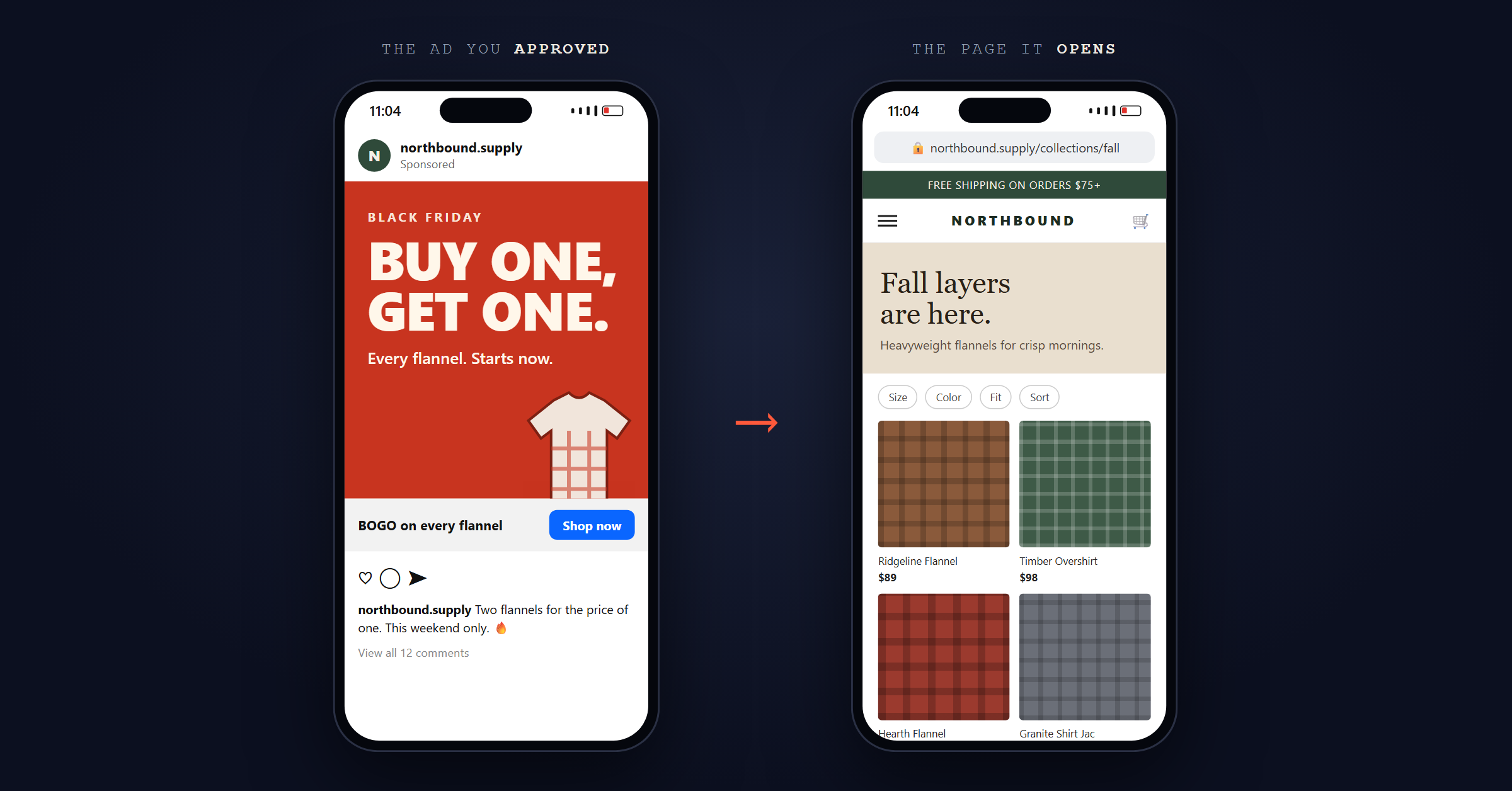
Some night in the next four weeks you're going to approve a BOGO ad at 11pm, push it live, tap it on your phone, and land on a collection page still selling fall layers. The ad says buy one, get one. The page doesn't mention it. The shopper scrolls, goes looking for the deal, can't find it, and leaves.
You'll know because you'll have done the tap. Then you'll open a ticket.
That ticket is the whole problem. Demand gen can launch forty ad variants in an afternoon. The page they point at changes when the web team gets to it, and in November the web team is in code freeze, because nobody wants a developer touching the site during the week that pays for the year. So the ads move, the page stays put, and every new launch widens the gap.
Everyone in demand gen knows this. Most of us have just decided to live with it.
The usual fixes run on the wrong clock
You can build a landing page per ad. Every page builder on earth will tell you it takes minutes. Sure, minutes per page, times forty ads, times the creative refresh you're doing the Monday after Thanksgiving, all built by the one person who knows the builder and is also running the ads.
The ticket and the builder both move at the speed of a project, and your ads move whenever someone on your team has a good idea at 4pm. The page has to follow the ad by itself or it won't happen.
What we built
Throughline watches your ad accounts. When a new ad starts spending, it reads the ad (copy, image, video), reads the page the ad sends people to, and rebuilds that page so it says what the ad said, using the site's own fonts, colors and layout.
It edits the page you already have, at the URL you already have. The destination link in Ads Manager stays exactly where it is, and so does every link in your emails. A line of code on your site swaps in the new version for the people who clicked that ad, and everyone else sees the page as it was. Same with email: forward us the campaign, and the pages it links to get rebuilt for whoever clicks from it.
You get a link, look at it on your phone, and approve it or toss it. Then you choose: split traffic 50/50 to prove it works, or send everyone to the new page.
Nobody has to tell us a new ad exists. Emma, who runs e-commerce at a DTC apparel brand we work with, asked on a call whether she should be letting us know when new ads go live. She doesn't need to.
"This is the easiest collab ever," she told us. "You guys just send in ideas, and we're like, that looks good."
What she checks for is whether it looks like her brand. "The style seems to be very consistent with the site," she said. "All those updates just naturally are blending in well."
The guy who didn't buy it
Jonah, her partner on the e-commerce side, was less charmed, and he had a point. When a SaaS product "claims a mondo benefit, especially when it feels like it's relatively light touch," he said, "it just tends to not feel real, and often in my experience, it often isn't real."
I've bought those products too. I have the annual contracts to prove it.
He also called out our early work, which was "literally almost lifting a snippet of text from the ad and throwing it in the subhead." Yep. That was version one. The pages do a lot more now. On one of their collection pages, the rugby shirt from the ad sits at the top and comes back again at the bottom.
Revenue per visitor on their rebuilt pages is up 45% over the originals. Which is exactly the kind of number Jonah just told you not to trust, so he gets the next word too.
Jonah's theory for why the small stuff works: "Simple can be really good, and not f***ing with things too much, but making slight tweaks, I think, is where a lot of the margin is."
What they're doing with Black Friday
Emma's plan for their BOGO sale is to skip the 50/50. "Instead of doing a 50/50 A/B test, maybe lean more on what Throughline can update for us…" she said, "especially that sale."
That's the right call. Once the rebuilt page has beaten the original, splitting traffic during the biggest week of the year means sending half of your most expensive clicks to the worse page on purpose.
Jonah went one further. Around planned events, he wants the post-click experience worked out "before the fact," so the page is ready the moment the ads go live. Your creative calendar for the next four weeks is already written. The pages those ads land on are the part nobody has scheduled.
Go tap your own ads
Tonight, pull up every Black Friday ad you've got queued and tap through each one on your phone. If every page tells the shopper the same thing the ad did, you don't need us, and I'd like to know how you pulled it off.
If you find one that doesn't, send me the screenshot. I'll show you what the page should have said.