
Pull up the last email your team sent. Read it. Then click the button and read the page it takes you to.
Now count what the email said that the page doesn't. The offer. The product angle. The person the email was written for. The reason to buy this week instead of next month.
We went through our clients' emails and the pages they link to, claim by claim. On average, about 40% of what the email said was nowhere on the landing page. Some pages were missing 20%. Some were missing 70%. The customer clicked because of a specific promise and landed somewhere that had never heard of it.
Why it goes missing
Nobody did anything wrong here. The two teams just work on different clocks.
Your email team writes a new story every week. Monday it's a gift guide for dads, Thursday it's a restock on the product that sold out, and next week it's a pitch to people who bought once and never came back. Each email is written for a specific person with a specific reason to click.
The landing page was built once, for everyone, and it's been sitting there ever since. Updating it means a ticket, a designer, a developer, and a sprint. That's fine for a homepage redesign and useless for an email that goes out Thursday and is old news by Monday.
So the email keeps moving and the page stays put.
What it looks like
An auto parts brand sent an email titled "Is Your Transmission Cooler Trying to Tell You Something?" The pitch was simple: know the warning signs and replace your cooler before it leaves you on the side of the road. The email also promised a lifetime warranty with accident protection on every product, and 0% APR financing through PayPal or Klarna.
The link went to the transmission cooler category page. The page had the right products and none of the rest. There was nothing about warning signs or breakdowns, no warranty, and no financing. The headline just said "Transmission & Oil Coolers."
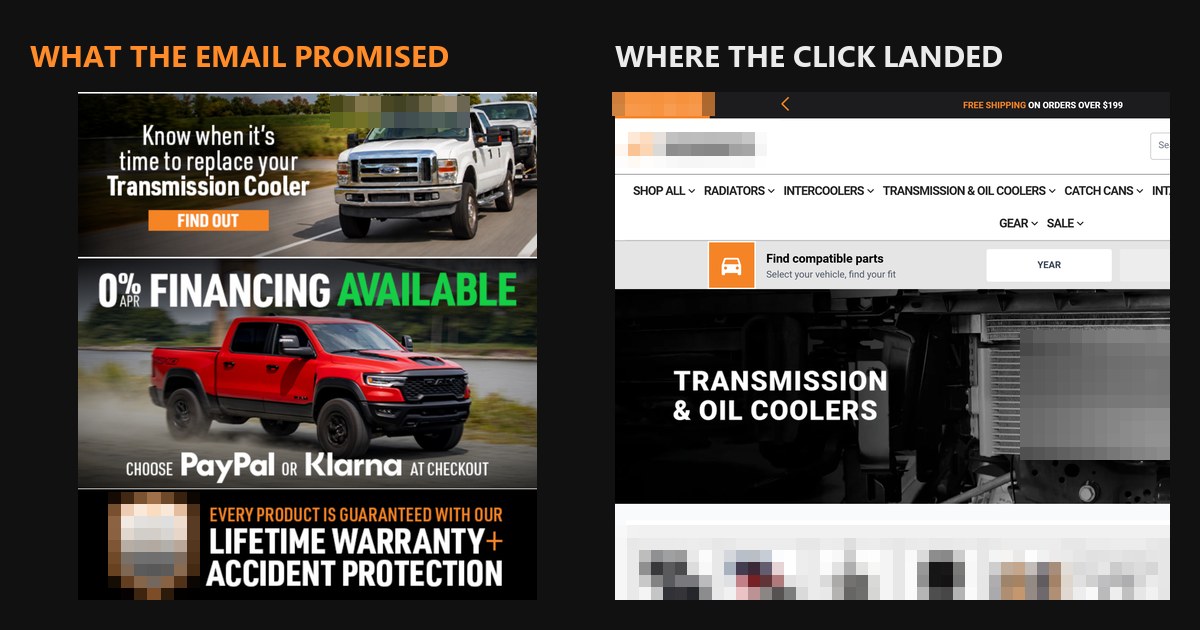
Someone who clicked because they were worried about a breakdown, and who wanted to know they could spread the cost out, landed on a product grid and had to take it on faith.
The fix
The page has to finish the story the email started. It doesn't take a new page, just a few additions for the people who came from that email:
- List every claim in the email: the headline promise, the offer, the product benefits, who it's talking to, the deadline.
- Check which ones the page already makes. Usually a handful are there.
- Add the missing ones, only for visitors from that email. A few lines of JavaScript keyed off the email's UTM tag does it:
const params = new URLSearchParams(location.search);
if (params.get('utm_campaign') === 'transmission-cooler-warning') {
  const title = document.querySelector('.category__title');
  title.insertAdjacentHTML('afterend', `
    <div class="email-match">
      <strong>Don't wait for the breakdown.</strong>
      Every cooler comes with a lifetime warranty and accident protection.
      0% APR financing with PayPal or Klarna at checkout.
    </div>`);
}
Someone arriving from Google sees the page as it was. Someone arriving from the email sees the page plus the things the email promised them.
Does it work?
Early results say yes. We've been running this same approach on paid social traffic, where the ad plays the role of the email. For one brand, matched pages converted 22% better than the originals over two and a half months. The ad or email already did the persuading. The page just needs to reassure the visitor they're in the right place.
The catch
For one email this takes an afternoon. Most teams send several emails a week, and each one has four or five links going to different pages. That's dozens of pages a month, every one needing its claims listed, gaps found, code written, tested, and switched off when the campaign ends. Nobody on the email team has that kind of time, and the dev team has a backlog of their own.
So we built a tool for it
Throughline does this for every email you send. Forward the email to your Throughline address. It pulls out every link, reads what the email promises, compares that to each landing page, and builds the matched version. Your team reviews it and approves it. From then on, email clicks see the matched page, everyone else sees the original, and a split test runs automatically so you can see the lift. Every link in one email puts visitors in the same test group, so the numbers stay clean.
Forward us your last campaign email. We'll send back a list of what your landing page is missing.