
Product extensions are the grid of catalog products Meta staples onto your ad. Someone taps the ad, and alongside your landing page they get a little storefront of tiles pulled from your product feed. Tap a tile, land on a product page. Most advertisers turned this on with a checkbox at some point and have never looked at it since.
I pulled ad-level insights broken down by product for every product-extension ad across five accounts we have data access to. 122 ads, roughly $270k in spend.
The grid takes a lot of your traffic
Depending on the brand, somewhere between 12% and more than half of all link clicks went through the product grid instead of the primary link. One ad sent 99% of its clicks that way.
So half your paid traffic can be taking a route you have never tested, onto pages you probably haven't looked at in a year.
And it converts better
For the two multi-product brands in the set, the grid clicks were the strongest clicks the ads produced.
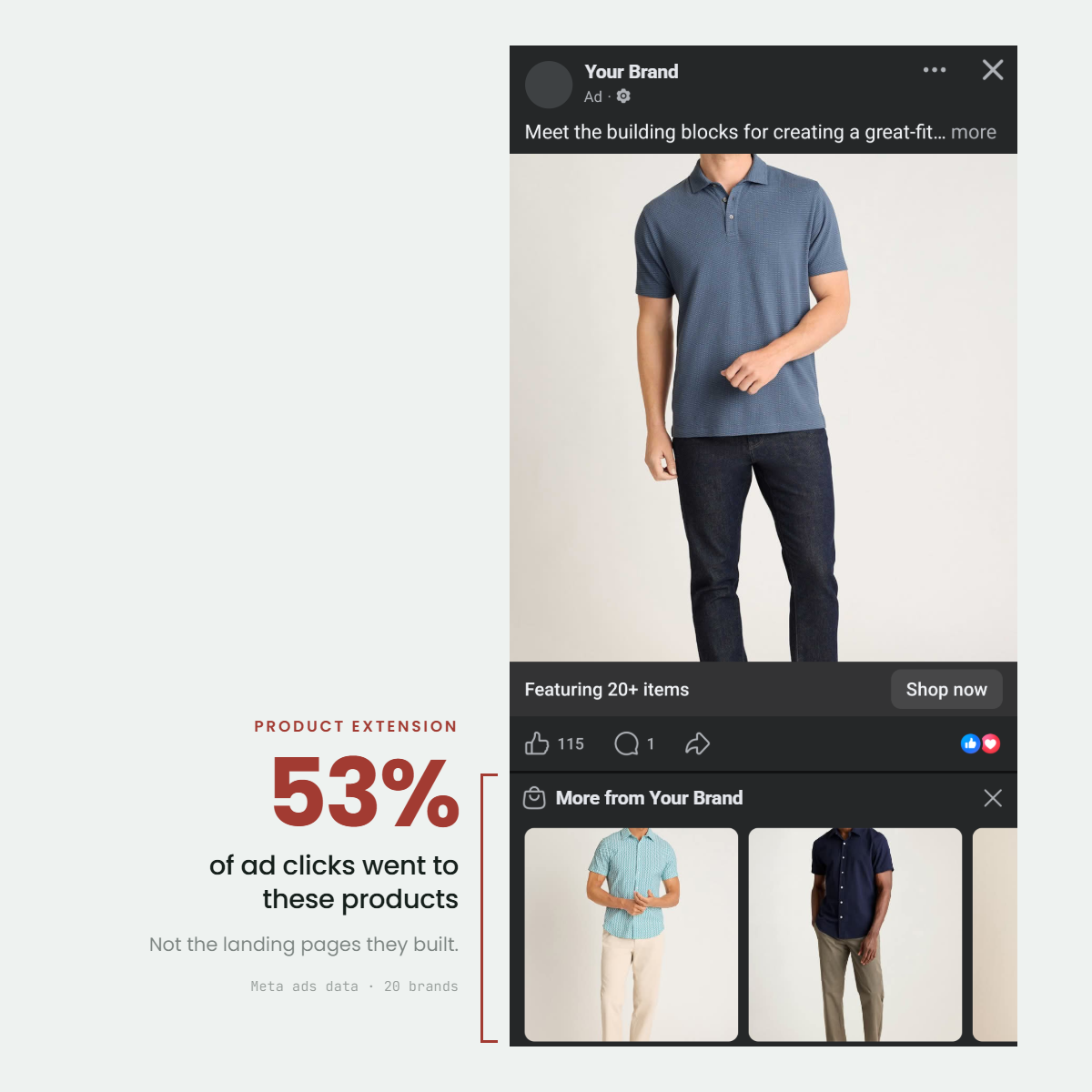
At the apparel brand, grid clicks converted at 5.8% against 2.1% for the primary link, with revenue per visitor of $8.26 against $2.46. Put differently: 53% of the clicks produced 79% of the revenue. At the menswear brand the gap was wider still, 14.2% against 2.3%.
Average order value came out nearly identical on both paths, which tells you the difference is conversion rate and not basket size. That makes sense when you think about who is clicking. Someone who taps your primary link liked your ad. Someone who taps a product tile liked your ad and then pointed at the specific thing they want. The second person is much further along.
Unless you sell one thing
The third brand sells a single high-ticket product, and for them the grid slightly underperformed the primary link. On their creator videos it was worse than that. One video pushed 89% of its clicks into the grid, where they converted at 0.2%, while the landing page was converting at 6.6%. All that warm traffic went window shopping.
So the honest answer to "do product extensions work" depends on your catalog. Real assortment at accessible price points, and the grid is your best-performing surface. One hero product, and it may be costing you.
Is it the product or the ad?
Mostly the product. Across one brand's ads, product identity explained 57% of the variance in which tiles got clicked, and the same few caps and accessories won almost everywhere regardless of what the ad was about.
The ad still steers it, though. Ads built around a specific accessory produced grids that converted at 11.7%. Brand-story ads produced grids converting at 3.8%. Same catalog, same tiles, three times the outcome.
The result I keep coming back to: at the menswear brand, grid clicks on products that didn't match the ad converted better than clicks on the product being advertised, 17.6% against 12.7%. People watched an ad for one shirt and bought a different one. The grid is doing cross-sell work inside the ad unit.
What I'd do with this
Start by pulling your own split. A product breakdown on your ad insights will tell you in ten minutes what share of your clicks are going through the grid, and for most people that number is going to be a surprise.
Then treat it as a decision. Big catalog, mid price points: lean in. One considered purchase: test turning it off, especially on video.
And look at where those clicks are landing. Every grid click skips the landing page you built for the campaign and drops someone onto a product page that has no idea which ad they came from. That is a lot of high-intent traffic arriving at your least prepared pages.
Standard caveats: this is Meta-attributed conversion data and not a holdout test, and a couple of the cells are small enough that I wouldn't bet the quarter on the exact figures. The traffic share is the part I would act on. That one is hard to argue with, and almost nobody is looking at it.