
How to steal budget for an experimentation program(me) and look like a genius
I love words that are spelled differently in British English and American English. One of my favourites is colour. There are many words that I somehow learned to spell the British way, and now that’s just my default.
I know the feeling.
Walking into the CFO’s office to ask for more marketing budget feels a lot like being a teenager asking your dad for gas money after you already dented the bumper. It’s painful, it’s awkward, and usually, the answer is a hard "no" followed by a lecture on fiscal responsibility.
But here’s the thing. You probably don’t need new money; you already have the budget, you just aren’t quite sure where to look.
The marketing budget trap
If you’re running a brand doing anywhere between $3 million and $100 million, I can pretty much guess your P&L structure without looking at it. You’re spending somewhere between 10% to 30% of your revenue on marketing. If you’re VC-backed, it’s probably higher, and your burn rate makes me sweat, but that’s a problem for future-you.
You love paid media. We all do. It’s the safe drug. It’s predictable. You put a dollar into the Meta or Google machine, and you hope to get four dollars back. Your ROAS is likely sitting right around 4x. It’s respectable. Everyone in the building understands the model, from the intern to the board.
But deep down, you know the truth. Ad costs are only going one direction, and your efficiency is plateauing.
How to steal the money
You know you should be allocating 10% to 20% of your budget to test new channels. Maybe it’s TikTok, perhaps it’s Connected TV, maybe it’s influencers.
Here is the unlock, though. Stop thinking of "On-site Experimentation" as a separate line item. And unlike TikTok, this channel makes every other channel perform better.
Let’s do some napkin math on a hypothetical $7 million store.
If you’re spending 15% on marketing, that’s about $1.05 million a year. If you are doing your job right, you’re allocating 20% of that for "Testing." That means you have roughly $210,000 sitting there, waiting to be torched on a new ad platform that might not convert or pan out this year.
You don’t need $200k to start onsite experimentation. You can run a killer Digital Product Growth program for under $75k a year. That money already lives in your "Test New Channels" bucket. You need to move it from one column to another.
Please don't try to hire this out.
Now, usually, this is the part where someone asks whether they can hire a full-time person at $75k.
Please don’t do that.
For $75k, you get a junior marketing coordinator who knows a little HTML and will accidentally delete your checkout button on Black Friday. You cannot hire a full team—Strategist, UX Designer, Developer, QA, Analyst—for that price. But you can hire a partner (hi, that’s us) for that price. And we won't break the site.
Proving you aren't an idiot
Okay, so you’ve stolen the budget. Now, the future you will have to prove to the boss that it wasn't a mistake.
Most agencies will bore you to death talking about Conversion Rate. We don't care about Conversion Rate. It’s a vanity metric. I can double your conversion rate tomorrow by lowering all your prices to $1. You’ll go out of business, but your chart will look great.
We care about Revenue Per Visitor (RPV). That’s the only number that pays the bills.
Let's look at the impact on that $7 million business.
Let's assume we run a solid roadmap. We aren't promising magic buttons, but let's say we get 6 winning experiments in a year. If each win increases your average RPV by 3%, it may seem small.
It’s not. 3% is significant when compounded.
But here is where the corporate calculators get it wrong, and where we need to get real.
First off, you don’t get all 6 wins in January. You get one in February, one in April, one in June, and so on. The first win generates extra cash for 11 months, while the last win might only generate it for one month.
Secondly, winning experiments don't last forever—user behavior changes. Competitors change. That shiny new feature becomes background noise. We conservatively estimate that a winning test degrades by about 15% every 3 months. Why? Because entropy is real, and humans get bored. This is precisely why experimentation isn't a "one-and-done" project. You have to keep feeding the beast.
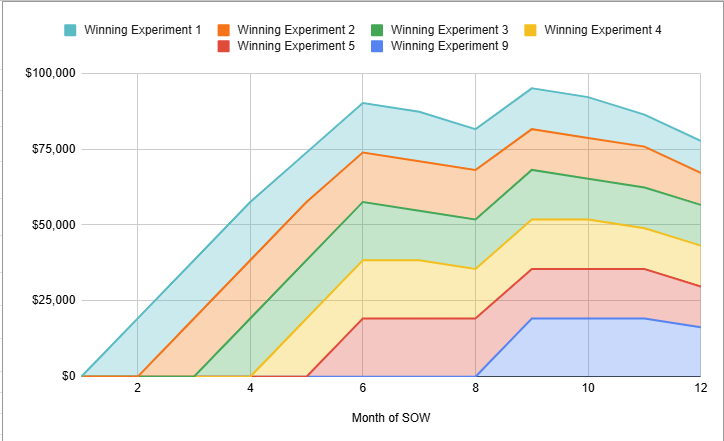
Compounding impact of experiments
So, is it worth it?
When you factor in the timing delay and the degradation, what are you actually left with?
On a $7 million business, a program like this can conservatively generate an additional $800,000 in year-one revenue.
That means you spent under $75k (which you diverted from the ad budget) to recover $800k. That is a return better than 10x.
And the best part? That $800k lift occurs on-site. Which means your Google Ads work better. Your email flows convert higher. Your ROAS increases across the board because you fixed the bucket rather than just pouring more water in.
You have the budget. It’s sitting right there, likely about to be spent on a "Brand Awareness" campaign that nobody can track. (I actually really like that brand awareness campaign, to be honest. It’s probably better than the retargeting campaign of people who were already going to convert.)
Take the money. Bet on your own product.
If you’d like to see precisely what this ROI model looks like with your specific traffic and revenue numbers, let's chat. I’ll run the calculator for you, and we can present it to your CFO together.
Check out what else we’ve been writing about or send Justin a message on LinkedIn.
Want more?
Make your job easier, let Mobile1st Grow RPV for you
At Mobile1st, we help e-commerce brands grow revenue per visitor.
We do it by combining customer-first research with testing and experimentation that cuts through the noise of dashboards and opinions. Our team uncovers what really drives purchase decisions, then runs experiments to prove impact — so you can stop guessing and start scaling
Want help? Reach out.
Driving E-commerce Growth Through Technology
Listen to the latest episode of season two of Checkin to Checkout.
