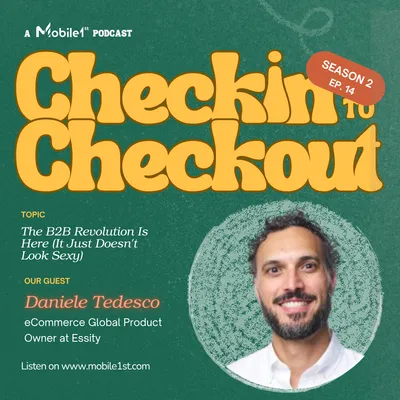
The B2B Revolution Is Here (It Just Doesn't Look Sexy) - Daniele Tedesco
Daniele Tedesco is responsible for e-commerce at a company most people have never heard of but everyone has touched. Essity makes $15B in annual revenue selling everything from the napkins at Dunkin' Donuts to incontinence products to medical compression devices. A billion people interact with their products every single day.
As Global E-Commerce Process Owner, Daniele and his team built a single commerce template on SAP Commerce Cloud that powers both B2B and B2C across 14 markets. On one end, they're shipping a single pair of compression socks directly to a patient. On the other, they're filling entire trucks with janitorial supplies. Same platform. Same instance. Wildly different customers.
But the most honest moment in this conversation isn't about architecture. It's about what happened when some of their brands pushed back on the enterprise solution. Not because it was broken. Because it wasn't fast enough for teams that wanted to experiment. Daniele's biggest learning: you can't police adoption. You have to attract people to it.
We also get into why B2B e-commerce is approaching a major inflection point, how distributor ownership is aging out and digital-native successors are demanding better ordering experiences, the difference between going headless and headful on the same commerce instance, why Essity started with B2C to learn lessons before tackling the B2B side where revenue is 100X larger, how AI fits into a manufacturer's world where brand trust and hallucination risk create real tension, why machine-readable data and GEO are the unsexy priorities that will matter most in the next 12 months, and how the "wedding cake" template model lets brands customize the top layer while sharing a common foundation underneath.
If you're managing e-commerce across multiple brands, multiple markets, or both B2B and B2C on the same platform — and you've ever struggled to get internal teams to adopt the thing you built for them — this one's for you.
Want any help Personalizing Every Customer Touchpoint? Check out https://Mobile1st.com
Interested in talking to Justin or getting on the show, find him on LinkedIn: https://www.linkedin.com/in/justinaronstein/
Key Topics:
- Attraction over policing: why forcing platform adoption across brands creates more resistance than buy-in
- Building a composable commerce template that scales across 14 markets for both B2B and B2C on SAP Commerce Cloud
- The "wedding cake" architecture: shared base layer, business-type middle layer, and brand-specific customization on top
- Headless vs. headful on the same commerce instance — and why different business units need different approaches
- Why Essity's B2B revenue is 100X their B2C — and why they tackled B2C first anyway
- The B2B e-commerce revolution: aging distributor owners, digital-native successors, and a growing digital maturity gap
- PunchOut as a channel for small and mid-sized B2B customers who don't have an ERP or EDI capability
- Why manufacturers approach AI differently — back office enablement first, customer-facing later, because hallucination risk meets decades of brand trust
- Machine-readable data and GEO as the next SEO — the unsexy cleanup work that will separate winners from everyone else
- How professional buyers already expect Amazon-level digital experiences at work and the gap is only growing
- The Project Hail Mary connection: invisible infrastructure layers that executives never appreciate until they break
- Why capability-focused conversations create neutral ground when internal teams get stuck debating tools
Transcript
Justin Aronstein: Welcome to Check In to Check Out, where today we're celebrating Daniela Tedesco's birthday, who is the global e-commerce process owner at Essity. Welcome to the show, Daniela. What is your role and what does that, it's a big role, what's it mean?
Daniele Tedesco: Yeah, thanks for having me guys. Love the show. I'm happy to be here and it's a total pleasure. Yeah, so my role is global e-commerce process owner and I work at Essity. And my focus is really around driving capabilities. And I like to summarize it basically in three S's, right? So it's streamlined business processes, speed to market and seamless customer experience. So my role is to work with our major global brands and brand owners and product owners to drive consistency, scale, and deliver a strong customer experience for our direct e-commerce.
Justin Aronstein: And so explain to all of us, what does Essity do? It's a huge company. So what are all the different parts of it and what do you touch?
Daniele Tedesco: Yeah, yeah. Essity is a global health and hygiene company. We are selling in over a hundred countries. We make 15 billion in annual revenue and we make everything from the napkins that you get in Dunkin Donuts to the paper towels in the airport, to incontinence products for your loved ones and fem care and even medical devices around compression and wound care. So we're in your hospitals, your airports. The fact that I love Justin is we touch a billion people every day. So try to wrap your head around that. It's really amazing. A billion people's skin is being touched by Essity products every day. So, you know, in order to reach and deliver at that scale, we need to really have a robust omnichannel strategy. And my world is really focused on delivering a first in class customer experience around our direct approach for both B2B as well as B2C.
Justin Aronstein: And what percentage of your time, of your energies around B2B versus B2C? There are two different problems to solve. Unique.
Daniele Tedesco: Yeah, absolutely. And you know, because we're a manufacturer, we don't have like this kind of robust engine that many of your maybe other guests have had around like retail and merchandising. So when it comes to B2C, it's mostly about building brand equity. So our strongest direct to consumer B2C web shop is around Tena. And this is our global incontinence product. And this is a taboo product, right? So our consumers, they don't want to get caught in that pharmacy aisle or maybe they're discovering and researching it for their loved one. So we found a really nice niche of customers that want to buy directly from us. They trust us. Maybe they're learning about it. And then they use our retail channel. So it's not an either or. So it's not like stealing from one or the other, but then they'll use either Amazon or our big retail channels.
Daniele Tedesco: So my focus around B2C started, my role started seven years ago and it was a real heavy focus on B2C because we wanted to understand and leverage a consumer experience and bringing that over to the really the bigger portion, which is the B2B. So our B2B revenue and sales that we generate on our direct platform is 100X what we do on B2C. So really, it's three quarters of my time is on B2B and one quarter is on B2C, but both are near and dear to my heart. Part of my role was to have, to create not just the strategy and to create these templates that we can get into more, but really to create an operating model that can leverage scale. So we share resources between product teams for B2B and B2C.
Justin Aronstein: Okay, and go ahead, Jonathan.
Jonathan Silverstein: I just found the name of the company is very interesting, Essity, sort of essential and necessity, which is really fascinating.
Daniele Tedesco: Yes, nailed it. You nailed it, Jonathan. Yeah, that's right. We are a fairly new company as far as that brand. It is just about seven years old. Prior to that, it was SCA, which was an acronym. And yeah, there's not a lot of names out there. So Essity really fit us well. So it hits on both of those.
Jonathan Silverstein: No, and it's got a human emotion. It's got a business emotion. So it's well done. And it's massive, 36,000 employees. It's a big group, 150 companies. And as you said, touches a billion people. So that's a lot of responsibility or at least ownership and it can get heady. But curious, so we know you're 75% B2B, 25% B2C. But who are you interacting globally? Like, how does your day look? Like, is it frenetic? Is it organized? Is it exciting? Talk to us.
Daniele Tedesco: Yeah, yeah. So we spent a lot of time building the templates, right? And that was a different phase. And I like to split it into three, right? We did a strategy discovery phase, you know, for a year or two, where it started to really build out, okay, this is what makes sense. We're going to build a framework, a template that can scale to any brand, any geography for B2C. And then we're going to tackle B2B. And then the second part was really the doing, right? So this is like we're working day in and day out with the product teams, the technical leads, the architects to build both of these templates that are built on the foundation of SAP Commerce Cloud, but they leverage all of our whole digital ecosystem, right? So our ERP, our PIM, all of our data stack, right? And then now it's about rolling out and scaling.
Daniele Tedesco: So this past two or three years has really been about getting our global reach. For B2C, in a couple weeks, we'll be live in 14 markets, and it's all built and managed under one product team. And it's just really a handful of resources centrally. And then we have all these local folks that are driving it and driving the sales and the localization and fitting those customer needs. So my day to day is really about connecting with the product team and working closely with them, making sure the high level backlog of our capabilities is visible, apparent, driving some of those discussions, right? So I drive the next big phase for us for our B2B for the medical shop is PunchOut. So it's another way to leverage the same technology but in a different ordering platform. And we were talking a little bit earlier about a lot of our revenue and sales drive is driven through EDI. So PunchOut is another way for us to touch those small medium sized customers who can't, don't have the luxury of using an EDI or don't have an ERP. So that's where we fit is this kind of small medium high profit, smaller revenue category of customers.
Jonathan Silverstein: Amazing.
Justin Aronstein: So you've mentioned this word template a few times.
Daniele Tedesco: Yeah, great question. So I'll just use our Tena B2C web shop for simplicity purposes. So we have a basically a composable storefront. So we can kind of quickly slap in a new brand and leverage a lot of the same pages and structure and checkout experience. So the template is integrated and connected to all of our independent and dependent integrations. So that's where the bread and butter of the template really sits is this base layer. So it's like a wedding cake, if you will. So there's this base layer of code that's shared between B2B and B2C because both instances are on the same solution. Then there's this middle layer where we start to kind of localize B2B needs and B2C needs. So B2C has this guest and logged in and logged out experience. On the B2B side it's more primarily you're kind of held out by a login wall, so there's a different public experience on the B2B side. And then at the top of this cake is the real flexibility that the business and the brands want. So this is where they can add their minutiae and the things that make it really relatable to their specific target demographic, right? If it's femcare versus incontinence, you have different types of users that need different types of information.
Daniele Tedesco: So that's how the template is in theory. What it looks like for B2B is it's this fantastic thing now that we've built for two business units and we're driving a lot of revenue through. On one business unit, our professional hygiene, our Tork brand, they have a headless solution. So we're purely the commerce engine behind. We're driving all the sales, connecting to the logistics and warehouse and all the orders received and making sure that that's working really well. On the medical side, it's headful, but it's using the same instance on Commerce Cloud. On the medical side, we're handling also the experience side, right? All on Commerce Cloud. And that's where you get this scale effect, right? Because now you have two business units, totally different go to markets. On the medical side, it's primarily manufacturer to pharmacy, and in many markets like the US, it's B to B to C or patient. So we're, you know, our pharmacy is placing an order and it's a very specific SKU, and that's flowing through us directly to the patient. And that's a wonderful thing that we wouldn't be able to offer without an e-commerce template. And then on the Tork side, the professional hygiene, it's the napkins, really bulky products, sanitizer that you see in the airport. They're ordering truckloads, right? So on one side you're mailing a pair of socks and the other side you're filling up an entire truck, right? But it's all powered under the same tool.
Justin Aronstein: I love it. And so you're using Commerce Cloud, maybe not for all the stores, but for some of them. And I wanted to give them that context for a minute, because there's always the conversation on LinkedIn. How does Salesforce Commerce Cloud even compete? Why does this even exist when Shopify is so good? Like, why does it even have a tool? But you're obviously not on Shopify for many different reasons, and you're finding Commerce Cloud to be the right answer because -- finish that.
Daniele Tedesco: Yeah, yeah. So, okay, so a couple things with this debate and it is a debate and it's a healthy debate. So this kind of connects to like one of the biggest learning moments that I've had, right? It's actually SAP Commerce Cloud, not Salesforce. But so when we built this template, I totally underestimated the passion of a few super users toward certain specific tools, right? And we really focused on building an enterprise solution that was robust, scalable, bulletproof, right? Like all of our orders would flow. We would make sure that we're integrated to all of our entire tech stack. But some of our brands really wanted to move quick and try and experiment and break things, right? And they didn't have 20 years of, we already had web shops for many years, right? So this was a point of contention and I just assumed, and assuming is kind of dangerous, right? Assumed that this would kind of all flow and funnel together into one solution.
Daniele Tedesco: What I realized later was we needed to provide flexibility in the operating model and be solution agnostic, right? So yes, we have an enterprise solution and 90% of the revenue is flowing through that, but it's not a one size fits all, right? And taking this mindset of attraction over policing, right? I think that's always a dangerous thing in a large organization. If you try to police, you'll create more resistance or more friction. You try to attract people to what you're trying to do and bring them along. So that's probably one of the biggest learnings. Thankfully, we experienced that on the B2C side prior to the B2B side and then we made changes to our approach and the operating model. And that's where we provided that extra flexibility of going headless for one business unit and headful on the other.
Justin Aronstein: Yeah, it's probably fun to manage both in different areas. So what's your e-commerce hot take right now?
Daniele Tedesco: Yeah, I think so. You know, we were talking about this offline and I think the B2B e-commerce revolution is here and I think in the next five years we are going to see a major inflection point. And I think this is driven by two major catalysts, right? The one being that professional buyers, your pharmacies, distributors, they are expecting more and each year there is a gap that's been growing. And there's a great Deloitte article that came out in February that talked about this digital maturity gap in B2B. So the user is already there, right? They've been using Amazon for 20 years on a personal level, then they go to work and they're expected to be fast, efficient and task oriented. And then they are interacting with subpar solutions, right? So there's this huge gap and there's proof in the revenue that if you are a manufacturer and you have a better maturity, you're getting 110% more margin than someone with lower maturity than our peers. Right. And so that's not incremental, that's transformational.
Daniele Tedesco: So there's that part. Then of course we can't forget AI, right. And I think gen AI is really going to drive product discovery across the board for e-commerce. I think there is still this trust factor that many of us humans have with our channels. So it's not going to be an either or, it's going to be an all of the above situation. Just like when everybody was afraid brick and mortar was going to die, you know, now we have this new channel, right? And I think the gen AI solutions out there are going to be phenomenal for product discovery on a B2B side, because as a consumer, you may have loose specifications that you need, right? But as a professional buyer, if you have the specs and you're just looking based on a couple variables, maybe availability and maybe price, you can really leverage a lot of efficiency through a tool that can scrub the web. So I think these two catalysts are going to really drive and expedite a lot of the B2B e-commerce that we have experienced.
Justin Aronstein: Completely agree, 100% agree. And I feel like at the same time, that same article was written 10 years ago. The internet was going to change B2B buying. And it did, but it didn't. You're still talking about EDI. I remember when I integrated my first EDI, the first thing I did as a software developer was like, OK, that was cool. But we haven't moved on. We're still waiting for the revolution?
Daniele Tedesco: Yeah, it could be, you know, it can be a 20 year revolution. But I don't know. So here's the take Justin. So prior to this role, I was in business strategy and I was driving digital transformation for one of our business units. And this is the thing that was alarming. This was about seven years ago. The statistic came out, our average customer, our distributor -- this might be a local distributor in Florida or the Southeast that sells janitorial services products -- their average age of ownership was 55 plus. Most of them were in their sixties. So two things are happening on that front. They're aging out and either their kids don't want to take it over and it's private equity that's buying it, or their kids are taking it over and they're digital natives from the get go, right? So I think that could be another factor here at play.
Daniele Tedesco: But you're right, habits die hard and a lot of systems that are embedded in a distributor or a pharmacy or a retailer are hard to switch over. So oftentimes manufacturers like Essity end up bending towards their channel, right, and making everything work. And now I think it's going to be the other way, where the channels are going to push for more. And the other thing is you've got to be discoverable, right? So you have to have, as a manufacturer, we have to have clean data. There was a statistic that most of ChatGPT's data is coming from Reddit or Facebook, right? Like the testimonials. We need to represent our own brand before someone else does. And I think that's also part of this revolution.
Jonathan Silverstein: I was going to say, you know, the two things that you both are talking about is really contextual relevance. And technology is a massive enabler, or accelerator I should say, to these things. So while I agree with you 100% that there's a revolution coming, it's a little chicken or the egg. Is it because the technology is enabling these things? And because the demand, as you just said, there's two target audiences, aging out and because digital natives are taking over, are demanding it. But now the technology is enabling it and accelerating this ability. So you catch the wave before or are you late to it? So it's 100% agree and it's a great hot take.
Justin Aronstein: And so for you on the B2B side, there's EDI, but people are in their AI tools all day, whether it's Claude, ChatGPT. Like I'm sure you probably spend two to six hours in an AI tool all day and anyone in B2B does, anyone in enterprise does. That's kind of their home almost. Are you guys building skills to be in these AI tools, these agents that will talk to you? Are you going that far? Is it more discoverability? Where are you guys in that kind of framework?
Daniele Tedesco: Yeah, great question. I think this is probably one of the hardest things. First of all, what we're used to investing in is diaper machines, paper machines, not digital tools, not digital assets, not digital capabilities. So that's one of the bigger things to deal with as a manufacturer, right? And maybe retail channels have a better leg up on a manufacturer. So when we look at AI, and the other part is, as we talked about, our brands are really sensitive. We've built years, decades of a relationship with our customers. So exposing them to gen AI, or to hallucination I should say, is something we're very sensitive to. So we're looking at it as back office. We're looking at it as enabling our own people and taking our time with it and finding the right products, right partners, to enable our people to move faster.
Justin Aronstein: Love that. Okay, so that makes sense. You're not building MCP servers to replace EDI -- like, hey, order via our MCP and see what happens.
Daniele Tedesco: I mean, it could be a totally different conversation in a year. Right. And I think that's the interesting thing. I saw in the same article, this statistic that specifically for procurement, 90% of businesses are using some kind of AI capability. Right. And I think that is a pain point that gen AI can address. It can create great, beautiful articles and summaries and papers but it also can help you do this discovery part that is maybe different than it was a year ago and it probably will get much more sophisticated in a year.
Justin Aronstein: And so to continue your take on B2B, what does that mean for your investments? So there's some back office things, but what do you see B2B e-commerce over the next 12 months?
Daniele Tedesco: Yeah, so the next year, I think the focus across the board is going to be machine readable data, right? And I think that should be the focus. A lot of this hype around, you know, I don't know, you hear about this solopreneur who's selling weight loss drugs and he has AI doing everything in the back -- I'm kind of tired of that and over it. I'm looking for digital tools to quietly remove effort, and for customers to not even notice. At the end of the day, if the customer doesn't need to email or call us, that's when something is well designed, right? That's when we've enabled AI in the right way. So I think the first step is really, it's not going to be sexy. It's going to be cleanup, normalization, syndication of data. So that the next SEO is GEO, and we're on the top of the list.
Jonathan Silverstein: Discoverability, yeah.
Justin Aronstein: Yeah, are you guys going to have people seeding Reddit threads?
Daniele Tedesco: You know, that is a fascinating thing. Personally, I'm not a Reddit user. Only when it pops up in my search results. But I think it's a really interesting power of community that is super valuable. At the end of the day, we're all human, and we really care about what other humans think. And that's where Essity plays. We create human products. We're very sensitive to touch and emotion. But the AI agent isn't, right? So we've created all of this fancy UI and all this emotional testimony to connect with humans. And now you have machines that are actually trying to get to the core question: is the product available? What's the price? And does it meet your specifications?
Justin Aronstein: Yeah, especially in B2B.
Jonathan Silverstein: Yeah. I was going to say that we interviewed Giovanni from Italy, if you haven't seen that episode, he's a great one. And he kind of talked about a similar point here -- brand push versus consumer driven. And it's that push and pull all the time. He's in Italy and coming face to face with more of the American mindset around consumer reviews driving your business. So even in a B2B situation, as you described earlier, B2B people are consumers too. And they have a consumer mindset and they've had an experience where the expectations, let's see what the reviews say, let's see what the customers say. So I like that you're sitting in both seats and it's not divided. So I just have a question, where do you like to spend your time?
Daniele Tedesco: Yeah. And I'll just add, I did catch that episode and it was near and dear to my heart because he was talking about pharmacies and selling to pharmacies, right. And that is a big customer demographic for our medical B2B shop. And what he highlighted is, it's not the fun part, but it's the complicated part, these nuances between different markets, geographies, how to sell into the US versus how to sell elsewhere. That's what makes it the secret sauce behind B2B businesses -- pricing, and also how to work with these different municipalities and get your products in front of the customer, right? It's not just you pay the best SEO and SEM. You have to really understand these nuances. So I liked that episode.
Daniele Tedesco: When it comes to where I like to spend my days, we have a launch coming up. I think these are the exciting moments -- the chance to get the team together and get behind it and see it go live in a new market or enact a new feature that customers have been waiting for. The hard part of my job is really when I get into these discussions around tools and you get dragged down by narrow sight around clarity and what is really important for the customer as opposed to opinions. I think my best way of mitigating that, and if your listeners are struggling with this in a big corporation, is really shift the focus to capability. Don't talk about system, talk about capability and how it relates to the customer. And that is going to create a neutral ground for all the opinions in the room.
Jonathan Silverstein: Great advice. All right, so where do you like to spend your time outside of work?
Daniele Tedesco: Well, I like to spend my time on my bike and skiing. That's pretty much on the personal side. Yeah, I know. I think if I can work with -- I'm an engineer at heart, I love learning about new capabilities. Like when we actually get to see something and see the power of it and how to integrate it into our web shop. Like now we're looking at a customer data platform that's going to really drive insights and segmentation to the next level for our B2B shoppers, which is very hard. We don't have Nielsen data in B2B, right? So we have to create our own segmentation and we have to create our own trends based on buying behavior. That's kind of fun, right? That's like you start to see the things behind the scenes that a lot of companies are doing, especially Amazon, and you can start to bring that to life in your own company.
Jonathan Silverstein: And that's the signal, the difference between the signal and the noise that artificial intelligence, as you were describing before, can't really tell. So that's where the human intervention can make significant decisions. I like that that's where you like to be.
Justin Aronstein: Yeah. And you should totally get on Reddit. If only to look at the city you live in and understand how people are talking about the city you live in and be a part of the discourse and even shape the discourse. Speaking of Austin, just how people talk about bikers versus cars in the city, which is a very bike friendly city, but has its fascinating dynamics. You become involved and you want to then go to city council because you see this discourse on Reddit. So definitely get on Reddit. But we were talking before the show started about Project Hail Mary. So let's talk about that a little. What are some of your thoughts on it?
Daniele Tedesco: Yeah, yeah, so I just finished this book and actually I got to see in person, it was 50 miles away, the Artemis 2 takeoff. So that was super cool. I'm just fascinated by sci-fi and I think this really, we needed a feel good story where you see the whole world kind of come together on one mission. I think that was also a big driver. But what really stood out to me was this idea of these two protagonists, these two leaders, these main characters and how they perceive the world. So the main character, the human being, able to perceive most of our world around visual optics. And then you have this other intelligent being who has no visible capabilities, uses echolocation. And that really starts to drive all these thoughts, right? What does intelligence mean? And it reminded me that there's this whole other world around us that we can't even perceive, right? There are these invisible layers.
Daniele Tedesco: And now we have the astronauts coming back from Artemis 2. And inevitably, whenever someone goes to space, they come back with this perspective -- I think they call it the overview effect -- where they see the world in a new way. They don't see countries and borders anymore when you go out there. They see this thing and this world differently. And I think the book also tried to create that. And to tie it back to business and e-commerce, the reminder is for CX especially: there are all these invisible layers behind the scenes and people never see them directly. Even executives won't appreciate that you built a master data governance tool. But the customer feels it. And they definitely feel it when it doesn't work.
Justin Aronstein: Yeah, I think another way to say this is that someone's perception is the reality. It doesn't matter what your reality is, their perception is the reality and you need to address that perception. You need to fix that or whatever and that's what you address. And of course, addressing what's driving that perception is the way to get there.
Daniele Tedesco: Yeah, great point. Great point.
Jonathan Silverstein: I saw the movie last Saturday and I'm not going to ruin it for anybody. To use your words, it is a great feel good sort of homogenizing thing -- like we're all together in this. And to your point, our first order of business always is to figure out how we communicate and connect, in this case between these two beings. Amazing story. And I love how you brought that back. Nicely done.
Daniele Tedesco: Yeah, I mean, it does come down to communication, right? If you can communicate, you can accomplish anything.
Jonathan Silverstein: And understanding, and coding this thing and understanding where it comes from -- reference points and embedded beliefs and thought patterns that you carry with you. That is omnipresent throughout the movie. And then when you learn the other side, you appreciate it, you become a greater empathy. So the more we interact with others, the more we understand. It's great.
Daniele Tedesco: Absolutely. Yeah. Different perspectives, same destination.
Jonathan Silverstein: Nice.
Justin Aronstein: Awesome, well thank you so much for your time. This has been absolutely amazing. Where can people find you? What are you working on now?
Daniele Tedesco: Yeah, I'm on LinkedIn a lot. I try to keep a regular cadence of sharing ideas there. And I attend a couple different conferences a year. I'm going to SAP Sapphire in a couple of weeks. So that's exciting. But yeah, I think LinkedIn is probably the best way to reach out.
Justin Aronstein: Awesome. Well, thank you so much for your time.