
This week on Checkin to Checkout: Josh Johnston, Senior Director of Online Experience at Trail Appliances, talks about surviving replatforms, weaponizing customer data in executive forums, and building an AI chat widget that drove a 4x conversion lift.
You've done the work.
Your Meta ads account is a thing of beauty. You've got 47 creatives running across six audiences. You've tested hooks about protein content, hooks about taste, hooks about convenience for busy parents. You've got UGC, polished studio shots, and that one weird iPhone video your founder shot at 6am that somehow outperforms everything.
Every week, your media team is in there cooking. New angles. New formats. New offers. New objection-busting copy. They're testing carousel vs. single image. Short-form vs. long-form. Pain point leads vs. aspiration leads.
They're doing it because they know the game has changed. Creative is the new targeting. And they're right.
But here's the part nobody talks about.
All of that beautiful, segmented, persona-matched creative is driving traffic to the exact same landing page.
The same static page. With the same headline. The same hero image. The same value props in the same order. No matter which ad someone clicked. No matter what promise convinced them to tap through.
Your ads are having 47 different conversations with 47 different people. Your landing page is having one conversation with everyone.
And it's the wrong one for most of them.
The Protein Oatmeal Problem
Let me give you a real example because I've seen this exact scenario play out with enough clients that it haunts me.
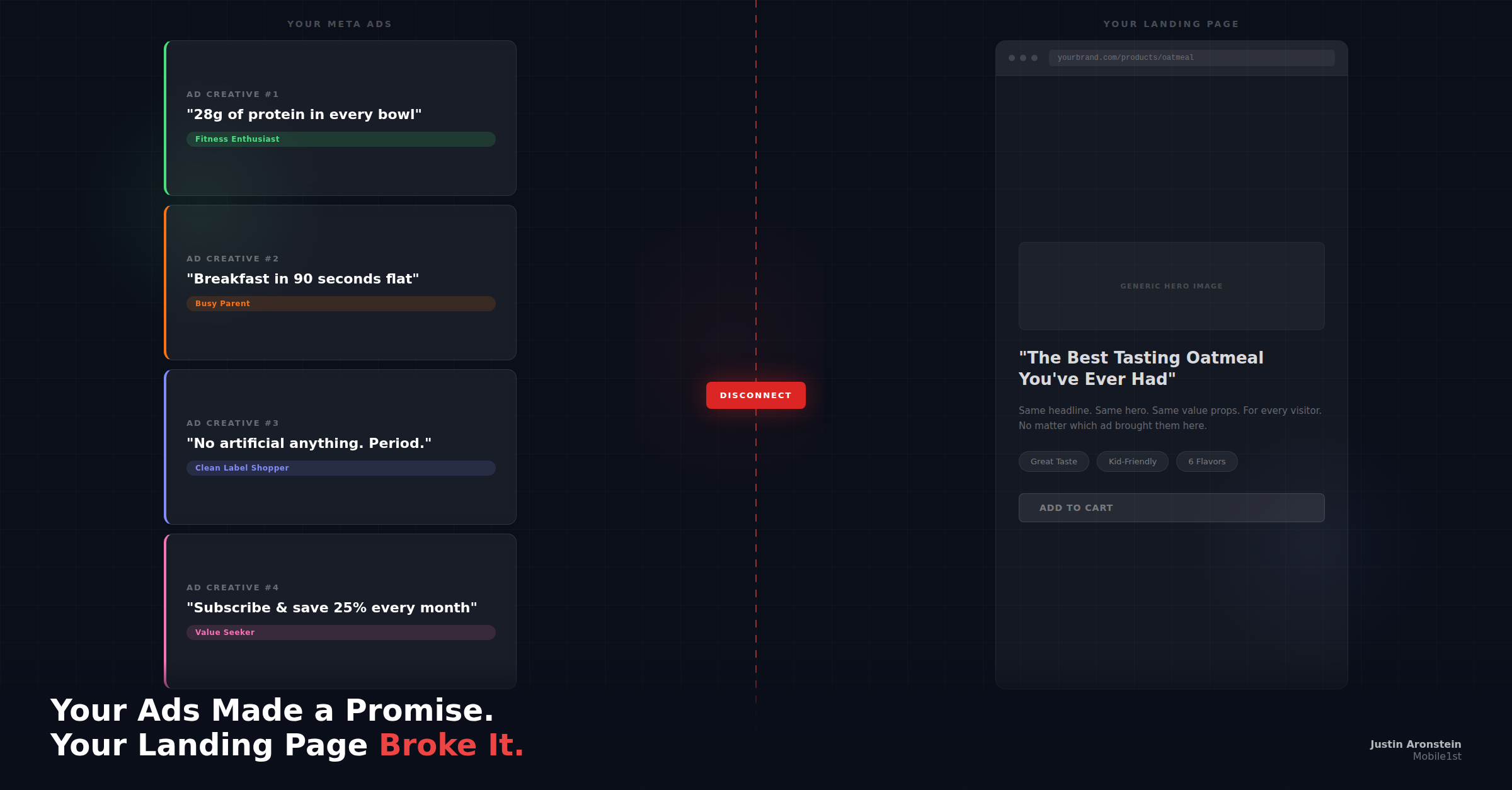
A brand sells oatmeal. Good oatmeal. They've got a strong Meta ads operation. One of their top-performing creatives leads with the protein angle. "28g of protein in every bowl." The ad shows a gym bag, a shaker bottle, and a bowl of oatmeal. The copy talks about how hard it is to hit your protein goals and how this is the easiest breakfast swap you'll ever make.
Someone who cares about protein sees that ad. They click.
They land on a page that says: "The Best Tasting Oatmeal You've Ever Had."
The hero image is a family at a breakfast table, smiling. The first three value props are about flavor variety, kid-friendly options, and a money-back taste guarantee.
Protein? Mentioned once. Below the fold. In the fourth bullet point of a section most people never scroll to.
That customer came looking for a protein solution. They landed on a taste pitch.
Some of them will convert anyway. The product is good. The price is fair. But a meaningful percentage of those protein-motivated visitors just bounced. Not because the product was wrong. Because the page didn't finish the conversation the ad started.
Now multiply that by every creative you're running.
The ad about convenience for busy parents lands on the same page as the ad about clean ingredients. The ad about the subscription discount lands on the same page as the ad about the founder's story. Every single ad, with its carefully crafted hook and its specific persona target, lands on a page that ignores all of that context.
It's like running a personalized email campaign where every link goes to your homepage.
If this sounds like your ad account right now, we built something that fixes it automatically. Keep reading and I'll show you the data.
Your Site Doesn't Know What Ad They Clicked
This is the core of the problem, and it's so obvious that most teams just… accept it.
Your media team spends hours every week building creative that speaks to specific people about specific things. They vary by persona, hook type, format, offer, persuasion angle, and objection. They know exactly who they're talking to in each ad.
Your site knows none of this.
When a visitor lands on your page, your site has zero context about where they came from or what convinced them to click. It treats the protein-obsessed CrossFit guy exactly the same as the taste-focused mom looking for something her picky toddler will eat.
And look, your site is good. You've optimized it. You've thought about the big problems customers are trying to solve. You've got solid product photography, clear pricing, and a checkout flow that doesn't make people want to throw their phone.
But it's static. It's a fixed experience that tries to be everything to everyone, which means it's not quite right for anyone.
The ad did the hard work of finding the right person and saying the right thing. Then the landing page undoes half of it by changing the subject.
What Happens When the Ad Matches the Page
We started noticing this pattern a few years ago. Client after client, the same disconnect. Incredible ad programs feeding traffic into landing experiences that had no relationship to the creative that drove the click.
So we tested it.
We took clients who were already running strong Meta creative and matched the landing page experience to the ad. When someone clicked an ad about protein, they landed on a page that led with protein. When someone clicked an ad about taste, the page led with taste. Same product. Same price. Same checkout. Just a different conversation based on what the visitor already told us they cared about.
The results were hard to argue with.
Revenue per visitor went up 20% or more for those matched experiences.
Not conversion rate. Revenue per visitor. The number that actually tells the truth about whether your site is working.
And it makes intuitive sense if you think about it. You already did the hardest part. You already found the right person and got them to click. All you have to do is not change the subject when they arrive.
That's a low bar. But almost nobody clears it.
We're giving newsletter subscribers a free month of Throughline to see this for themselves. Subscribe to The Director's Cut and we'll set you up.
Why Nobody Does This (Even Though Everyone Should)
If matching ads to landing pages is so obviously valuable, why aren't more teams doing it?
Because it's a nightmare to execute manually.
Think about what it would take. You'd need to catalog every active creative. Classify each one by persona, hook, funnel stage, and offer type. Then build or modify landing page variations for each classification. Then set up the routing logic so the right visitor sees the right page based on the right ad.
For a brand running 50+ creatives, that's an enormous amount of work. And it changes every week as your media team launches new creative and pauses underperformers.
Most e-commerce teams are already stretched thin. The Director of E-Commerce is already juggling platform migrations, email calendars, inventory headaches, and a CMO who wants to "protect the brand story." Nobody has time to build and maintain a manual ad-to-page matching system.
So teams just accept the mismatch. They optimize the landing page for the broadest possible audience and hope for the best.
It's not a strategy. It's resignation.
We Built Throughline Because We Got Tired of Watching This Happen
After seeing this same problem with client after client after client after client, we built a solution.
It's called Throughline.
Here's how it works.
We download all of your Meta ads. All of them. The images, the videos, the CTAs, the copy, the headlines. Everything that's live in your account.
Then we ingest all of that creative and classify each one across multiple dimensions. We calculate the persona it's targeting. We identify the funnel stage. We determine the hook type. We classify the persuasion angle, the objection being addressed, the offer structure, and several other dimensions that matter for landing page relevance.
Once every creative is classified, we can dynamically update the landing page to match the ad for anyone clicking through that specific creative.
Protein ad? Protein-led landing page. Taste ad? Taste-led landing page. Convenience-for-busy-parents ad? You get the idea.
Same product. Same checkout. Same brand. Just a landing experience that actually continues the conversation your ad started instead of starting a new one from scratch.
The visitor doesn't know anything changed. They just feel like the page "gets" them. Because it does. It knows exactly what brought them here, and it speaks to that.
The Math Is Simple
Your media team is already doing the hard work. They're testing hooks, iterating on creative, finding the angles that resonate with different audiences. That work is generating clicks.
But every click that lands on a mismatched page is a leak. You paid for that click. You earned that click. And then your static landing page fumbled the handoff.
When you match the landing experience to the ad creative, you're not adding a new channel or increasing spend. You're making every dollar you already spend work harder.
Our clients have seen 20%+ gains in revenue per visitor when they follow this process. That's not a rounding error. On a $10M revenue base, that's $2M you're leaving on the table because your landing page doesn't know what your ads are saying.
Want to See It for Yourself?
If you subscribe to our newsletter, The Director's Cut, we're giving away a free month of Throughline so you can see what matched landing experiences do for your numbers.
No pitch meeting. No demo you have to sit through. Just connect your Meta account, let us classify your creative, and watch what happens when your ads and your landing pages finally start speaking the same language.
Because your media team is already doing the work. Your landing page just isn't listening.
Justin Aronstein is Chief Product Officer at Mobile1st, where he helps e-commerce brands grow revenue per visitor through experimentation and ad-to-page personalization. He also co-hosts Checkin to Checkout, a podcast for e-commerce operators who'd rather build than babysit dashboards.