
On this week's Checkin to Checkout, Lauren Goodwin joins Justin to dig into the question every e-commerce brand needs to answer before any tactic makes sense: why you, why now? If you're building the case internally for where to invest next, it's worth a listen before you keep reading.
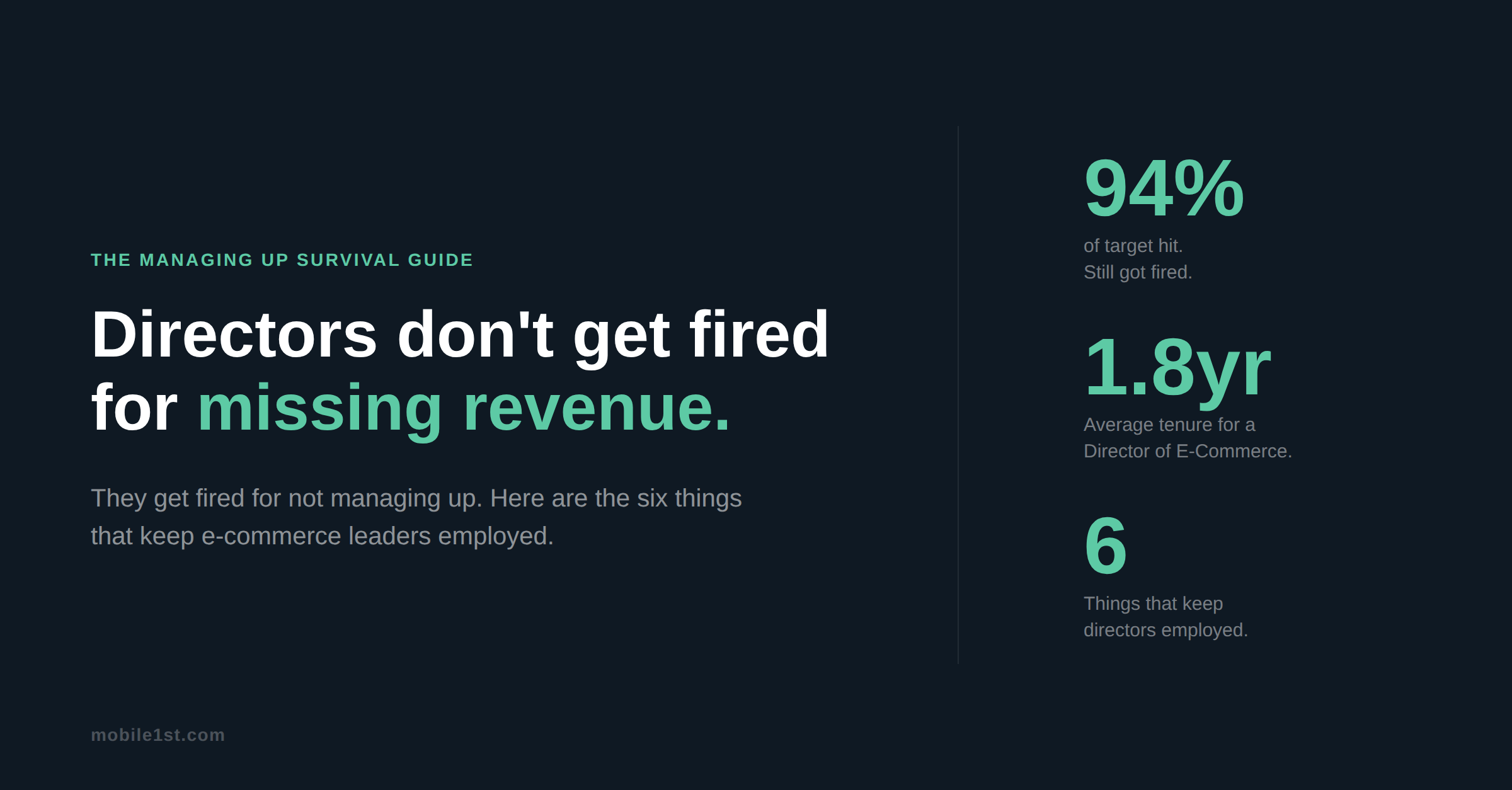
Someone I know hit 94% of their revenue target last year. The business was genuinely growing. The team was executing. The roadmap was smart.
They were gone in 18 months.
Not because the strategy was wrong. Because the CMO didn't feel informed. Because the CFO got surprised by a Q3 dip they should have seen coming. Because the CEO walked into a board meeting and didn't have the story.
Nobody fired them for bad performance. They fired them for making leadership feel out of control.
This happens constantly in e-commerce. And the people it happens to are almost never the ones doing a bad job. They're the ones so buried in doing the actual work that they forget to tell anyone about it.
Most directors learn this lesson after it costs them something. Here's how to learn it before it does.
Your actual job is making your boss look smart in front of their boss
Most Directors of E-Commerce think managing up means "don't surprise people." That's the floor. Not the ceiling.
The real job is giving leadership a story they can retell.
Your CMO needs to walk into a board meeting and sound like they understand what's happening in e-commerce. Your CFO needs a number they can point to when someone asks about ROI. Your CEO needs to feel like someone on the team has a plan and it's working.
If you're not providing those things proactively, someone else is filling the narrative vacuum. And their version of the story usually ends with your budget getting cut or your role getting "restructured."
Directors of E-Commerce already have two full-time jobs. The first is the one you were hired for: grow revenue. The second is the one you actually do every day: getting people who don't report to you to do work they don't care about, on your timeline, so you don't miss your number.
There's a third job nobody mentions. Keeping the people above you feeling confident about you. Not impressed. Not wowed. Just confident. That's the bar. And most directors never clear it because they're too busy doing the first two.
Six things that keep Directors of E-Commerce employed
1. The Friday 3-bullet Slack
A director I know has been in her role for four years. Two VPs have come and gone above her. She's outlasted both of them.
Her secret is boring. Every Friday afternoon she sends her CMO a Slack message. Three bullets. What's working. What's not. What's next.
Nobody asked her to do this. That's the point.
It takes her ten minutes. It gives her CMO everything they need to walk into any meeting and sound informed. It means her boss is never caught off guard. And when a VP above her gets replaced, the new person inherits a trail of receipts showing she's been delivering consistently for years.
Three bullets. Every Friday. That's it.
2. The "What If" model
Every director has been in this meeting. You're reviewing the quarterly scorecard. Revenue is up 30%. Traffic is up 40%. Looks like a massive win.
Then someone points at the Revenue Per Visitor column. It's down.
Right on schedule: "So did all those experiments you ran actually do anything? Or did we just burn cash?"
If you don't have an answer ready for that question, you lose. Not because the question is fair. Because the perception of failure is now in the room and you didn't control it.
Build a simple model that shows what RPV would have been without your experiments. Here's the logic: when you scale traffic aggressively, especially cold paid social traffic, RPV doesn't stay flat. It dips. That's not a failure. It's math. New visitors don't spend like returning customers.
Your "What If" model shows the gap. This year we ran 12 winning experiments. Combined, they lifted baseline RPV by 23%. Without those tests, with this much cold traffic, we wouldn't just be "down." We'd be underwater. And we would have missed the revenue target by 20%.
That's not a defense. That's a proof point. Have it ready before anyone asks.
3. Pre-announce the dip
If Q3 is going to miss, tell them in July. Not August. Not in the post-mortem.
A CFO who gets surprised is a CFO who fires you. A CFO you warned in advance is a CFO who defends you.
The framing matters: "Here's what's happening. Here's why. Here's the plan to recover." That's three sentences. You can deliver them in a hallway conversation or a one-paragraph email. The medium doesn't matter. The timing does.
Every director I've seen get fired for a bad quarter actually saw the bad quarter coming. They just hoped it would fix itself. It almost never does.
4. Own the channels you don't control
A director I was working with missed his Q1 goals last year. We did the whole forensic review. Paid channels were fine. RPV was decent. Site was performing.
Then I asked about email. He said, "Oh, I don't own email. That's Marketing."
Turns out they were sending one email a month. One. And he thought he could still hit his number by optimizing what he did own.
His CFO didn't care that email wasn't technically his department. 30% of revenue didn't show up. That was his problem.
If a channel affects your number, you need a relationship with whoever runs it. A weekly check-in. A shared dashboard. Something. You don't need to own the team. You need to own the conversation.
The best directors I know are internal lobbyists. They're in every room where their revenue is being discussed, whether they were invited or not.
5. Keep a win inventory
Start a running document. A shared Google Doc, a Slack canvas, a Notion page. Every time something meaningful happens, log it. The date, the result, the metric, and one sentence on why it matters.
It doesn't need to be polished. It just needs to exist.
When performance review season arrives, you don't scramble to reconstruct the narrative from memory. You pull up the inventory. When a new VP walks in and asks "what has this team actually accomplished?" you don't freeze. You send them a link.
The directors who survive long enough to get promoted are the ones who can prove what they've done without having to think about it. The win inventory is how you build that proof in real time instead of trying to recreate it under pressure.
6. The first 90 days with a new boss
Most of the advice in this post assumes a stable relationship with leadership. But the highest-risk window for any director is when a new boss arrives.
A new CMO, a new CEO, a new VP above you. They don't know you. They don't know what you've built. They're forming an opinion of you in the first three weeks whether you realize it or not.
The director I mentioned earlier who outlasted two VPs didn't just survive because of her Friday Slack. She survived because every time a new VP started, she did the same thing: she interviewed them.
Not formally. Just a conversation in the first week. "How do you like to receive updates? What level of detail do you want? What's the one thing that would make you feel like e-commerce is in good hands?"
Then she over-communicated for the first 60 days. More updates than she'd normally send. More context. More proactive flags. Not because the new VP needed it, but because she was establishing her rhythm before they established their expectations.
By the time they settled in, she was already the person they trusted. The person who made them feel informed. The person who never let them get blindsided.
If you wait for the new boss to tell you what they want, you've already lost the first 90 days. You set the tone. You define the relationship. You teach them how to work with you before they figure it out on their own.
Three ways directors accidentally get themselves fired
The dashboard dump.
You send a 40-slide deck full of metrics nobody asked for. You think thoroughness earns trust. It doesn't. Leadership's eyes glaze over. They walk away feeling less confident, not more. I once watched a CEO start writing an email while the director was mid-slide. Nobody told the director because nobody wanted to hurt their feelings. He was gone six months later.
The lone wolf.
You execute brilliantly in your silo. Numbers are up. Tests are winning. The site is humming. And nobody upstairs knows. You think the work speaks for itself. It doesn't. Work doesn't have a publicist. If leadership doesn't hear about it from you, they assume it's not happening. This is exactly what the win inventory solves. You can't publicize what you haven't logged.
The surprise miss.
You knew in June that Q3 was going to be rough. But you hoped the back-to-school push would cover it. It didn't. Now you're explaining a miss in October that leadership is hearing about for the first time. A miss they can plan for is a business reality. A miss they didn't see coming is a firing offense.
The directors who survive aren't always the most brilliant. They're the ones who never let leadership feel blindsided.
The person who got fired at 94% didn't lack skill. They lacked a communication system.
The director who's been in her seat for four years while two VPs came and went above her doesn't have a secret. She has a Friday Slack message, a win inventory, and the discipline to interview every new boss in week one.
Managing up isn't politics. It's the infrastructure that lets you keep doing the work you're actually good at.
Send the updates. Pre-announce the bad news. Own the channels that affect your number. Log your wins. Set the tone with every new boss before they set it for you.
Do those six things and you get to keep doing the part of the job you actually like.
Justin Aronstein is the Chief Product Officer at Mobile1st, where his team helps e-commerce brands increase revenue per visitor through experimentation and customer insight. If you're a Director of E-Commerce who wants a partner that helps you build the story, not just run the experiments, reach out at mobile1st.com.