
For a solid decade, e-commerce had one job: remove friction.
Shave 0.2 seconds off the load time. Move the Add to Cart button above the fold. Kill one more step in the checkout flow. The whole industry operated on one assumption. Demand already exists. Your only job is to not screw it up.
And honestly? It worked. For a while.
The Demand Capture Era Was Real
Here's what was actually happening during the golden years of e-commerce growth.
Distribution was the unsolved problem. For the entire history of commerce (we're talking the Silk Road, the British East India Trading Company, Walmart opening its 4,000th store) the game was always getting the product in front of the person who wanted it. Then Amazon came along and solved distribution for almost everyone. Suddenly any brand could reach any customer, anywhere, within a day.
That created a stretch of growth that felt like genius but was mostly timing. You put a dollar into Google Shopping, you got three dollars back. You listed your product on Amazon and sales showed up because people were already searching for what you sold. You optimized your site by removing friction because the demand was already walking through the door.
The entire optimization industry, my industry, was built on this reality. Reduce friction. Capture more of the demand that already exists. Revenue goes up. Everyone's happy.
But here's what nobody wanted to say out loud: we weren't growing demand. We were just getting better at catching it.
Then the Music Stopped
At some point (and you probably felt it before you could name it) the demand capture playbook stopped delivering.
You're still running the same A/B tests. Still shaving milliseconds. Still moving buttons around. But RPV is flat. Conversion rate won't budge. The friction is already gone, and the results aren't improving.
That's because the problem changed underneath you.
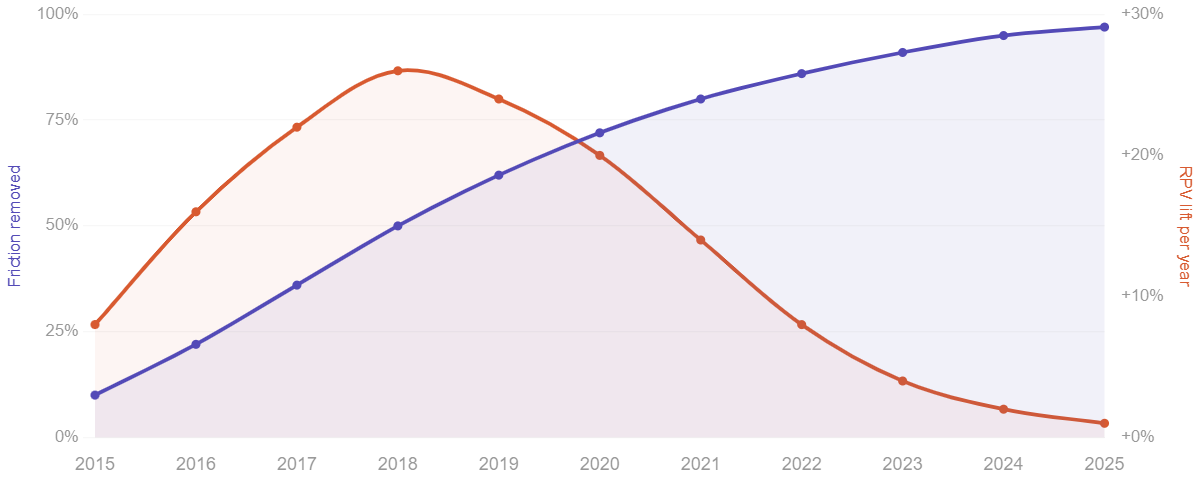
Distribution is solved. Amazon, Shopify, social commerce. A customer can buy almost anything from almost anywhere in almost no time. The brands that grew by riding that wave have now hit the ceiling. Every competitor has the same access to the same customer through the same channels.
When everyone has distribution, distribution stops being the advantage.
And when the demand that's out there has already been captured (by you, by your competitors, by whoever got there first) removing more friction doesn't create more customers. It just polishes an empty room.
We're in the Demand Generation Phase Now
The brands that are actually growing right now? Not reshuffling sales between channels. Actually growing. They've figured out something the rest of the market is still catching up to.
They're not optimizing for capture anymore. They're building demand that didn't exist before.
And it looks nothing like the old playbook.
I was talking to Dan Pierce, CEO at Sovereign Naturals, on a recent episode of Checkin to Checkout. He put it simply: "You can buy transactions, but you can't buy transactions where there isn't demand."
His team owns 70% of their category on Amazon. They've captured about as much demand as exists. So what does his team spend their time on now? Not bid adjustments. Not checkout optimization.
They brought a videographer on staff to document a product development process that's taken 14 years and counting. They're interviewing the doctors who recommend their products, not to pitch the product, but to tell the doctor's story and make their world bigger. They found out their team had been washing medical-grade bottles as an extra purification step for years, and instead of burying that detail, they turned it into content. Because that kind of specificity is what builds trust at scale.
Their content split is flipping. Less "here's 20% off." More "here's what it actually takes to make this product and why we're obsessive about it." More employee stories. More behind-the-scenes. More celebrating the people who use the product and letting them tell their own story.
Dan told me he obsesses over search volume now. That wasn't even on his radar five years ago. But if more people aren't looking for you, you're not growing. You're just fighting over the same pool.
That's what the demand generation era looks like in practice. It's not one channel. It's not one tactic. It's a team that wakes up every day asking "are more people looking for us than yesterday?" instead of "how do we convert more of the people who already showed up?"
The measurement changes too. You stop living and dying by ROAS on every campaign and start tracking brand momentum. Search volume trends. Social engagement that isn't tied to a promo code. You start investing in things that won't convert this week but build the audience that converts next quarter. And that's a hard conversation to have with a CFO who wants to see a return in 30 days. But it's the only conversation that matters right now.
Not because it's trendy. Because the math requires it.
Why This Matters for Your Site
Here's where this hits home if you're running e-commerce.
If you're still operating like demand capture is the game... if your optimization roadmap is still about reducing friction, removing steps, making the checkout 0.3 seconds faster... you're solving the wrong problem.
Your customers aren't leaving because they can't find the Add to Cart button. They're leaving because they don't have a reason to stay.
The site experience now has to do something it never had to do during the capture era. It has to make someone feel something. Build confidence. Tell a story that makes the price feel irrelevant.
That's a completely different optimization problem. It's not "how do we reduce friction?" It's "how do we increase the value someone perceives before they hit the buy button?"
And the teams that get it? The ones who stop kicking the vending machine and start asking why nobody wants what's inside it? Those are the ones who are going to win the next five years.
The Question Worth Asking
So before you run the next A/B test, before you rearrange the PDP one more time, before you try to squeeze another 0.1% out of checkout... ask yourself:
Am I solving for demand capture or demand generation?
Because if the demand isn't there, no amount of friction reduction is going to save you.