
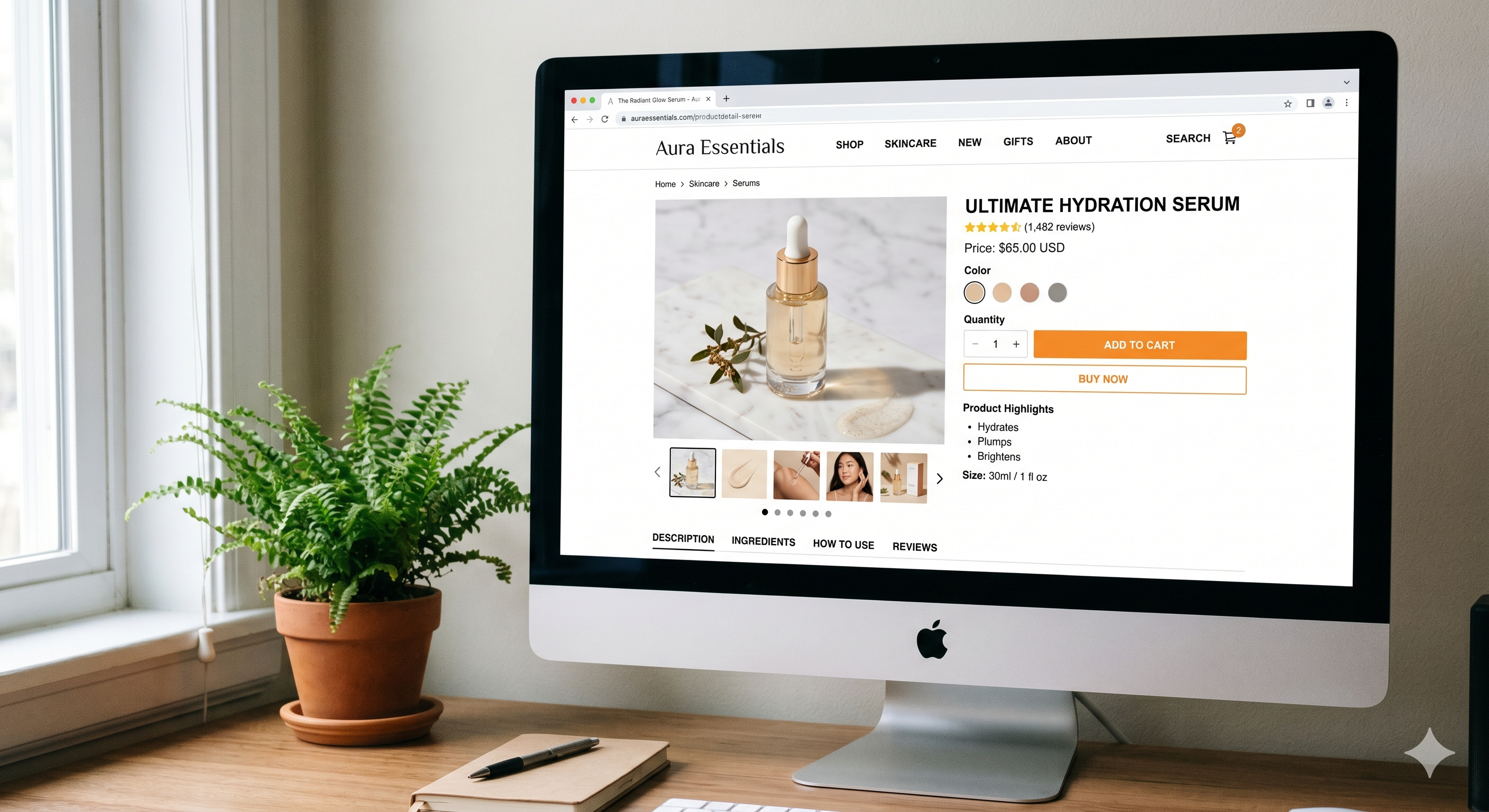
Pull up a stool, grab a drink, and let's talk about the biggest, most expensive lie currently sitting on your e-commerce site.
I'm talking about that product recommendation slider. You know the one. It lives on your Product Detail Pages (PDPs), your homepage, and your cart page, quietly cycling through individual products. Some SaaS sales rep swore up and down that its "proprietary, AI-powered, lookalike-behavioral algorithm" would automatically print money for your brand.
So you dropped a chunk of your budget on it, slapped it on the page, and called it a day.
The Multi-Million Dollar Lie in Your Tech Stack
Here is the unsaid truth your tech vendor doesn't want you to whisper in a board meeting: Product recommendation sliders are almost entirely useless.
They are the wrong tool for the job.
Think about how these algorithms actually work. They track past shopping behavior, look at what other people who viewed this item also clicked on, and try to guess the exact single product this specific human wants to see next.
It sounds smart on paper. But in reality? It's like trying to find a needle in a digital haystack. The algorithm might get warm, it might get close, but 9 times out of 10, it's recommending the wrong product. And when a user sees a slider full of single items they don't want, they don't keep clicking. They tune out. Banner blindness sets in. You lose them.
Stop Handing Them Needles. Show Them the Haystack.
So, what do you do instead? Stop trying to hand them the needle. Show them where the haystack is.
Instead of recommending individual products, you should be recommending groups of products: categories, cohorts, and pathways.
Let's look at an example. Say you run a golf gear brand and a shopper is looking at a premium Callaway driver PDP. The standard, lazy play is to show a slider with 10 other individual Callaway clubs. But they are already looking at a driver. Showing them a slightly different driver just triggers choice paralysis.
Instead, give them helpful, thematic pathways. Give them links to broader groups: Callaway Irons, Beginner Drivers, Customizable Drivers, or Left-Handed Woods.
Each of these choices doesn't force them into a dead-end product page. It takes them to a curated set of products where they can easily find the exact item they're looking for. It drastically widens your net. If they don't like the exact driver on the page, you aren't gambling your whole conversion on a single lookalike item. You're giving them a logical next step to stay on the site.
Context Is Everything: The Best Buy Checkout Rule
Of course, the strategy changes based on where they are in the funnel. It's all about contextual relevance.
- On the PDP: You want to offer alternative category paths to ensure the customer can find their right fit or build out their setup.
- In the Cart: You aren't trying to upsell them on an entirely different category of core product. You want quick add-on categories. Think of it like the candy bars, lip balm, and phone chargers lined up in the Best Buy checkout lane. You don't show them another TV in the cart. You show them a pathway to Cables & Power Protection.
The Proof: A 4.5% RPV Bump for a $100M Brand
We don't just sit around bars theorizing about this stuff at Mobile1st. We test it. We call our flavor of conversion rate optimization Digital Product Growth because we don't care about vanity metrics. We care about closing the gap between the click and the buy to scale RPV.
We recently ran a version of this exact category-routing concept for a sports retailer doing over $100M online. We completely bypassed the traditional single-item recommendation blocks. Instead, we built a new browsing mechanism in the form of dynamic "bubbles" right in the header.
These bubbles shifted and changed in real-time based on the user's live browsing and shopping behavior. The more they browsed, the more personalized the set of bubbles became. Crucially, these bubbles never took a shopper to a specific, single product. They routed users to targeted brand and category pages that the data suggested this specific shopper would care about most.
We ran the experiment for over a month. The result? A 4.5% increase in RPV.
But the headline number doesn't tell the most interesting part of the story. The secondary metrics are where it gets really interesting.
Only about 20% of first-time visitors interacted with the new bubble bar. That's expected. A first-time visitor doesn't have enough behavioral signal yet for the personalization to feel earned, and they're often still figuring out what the brand even is.
But for repeat visitors, interaction rates jumped to over 40%. The bar got smarter the more someone browsed, and that compounding relevance is exactly what kept them clicking.
Here's why that matters: returning visitors (people who'd been to the site more than twice) made up over 75% of total revenue. So the RPV lift on the segment that actually drives the business was significantly higher than the blended 4.5% number suggests. We were moving the right people, not just inflating an average across cold traffic.
And because this mechanism was built into the global header layout, it impacted 100% of the site's traffic. That is massive revenue left on the table if you're just letting a black-box widget guess individual SKU preferences. There is still a ton of optimization work to be done on fine-tuning our algorithm and content sets, but this exact architecture can, and should, be applied to every single part of an e-commerce site.
Real Personalization Requires Real Experimentation
For us at Mobile1st, 2026 is entirely focused on one thesis: Personalization means nothing unless it is verified through experimentation. Real site growth doesn't come from buying bloated personalization platforms. It comes from making every touchpoint contextually relevant.
That's the exact reason we built our newest product, Throughline. It's designed to automatically message-match your landing pages to the precise ad creative that drove the click in the first place, keeping the emotional hook alive.
We're currently recruiting e-commerce leaders (especially those doing between $3M and $100M who want to see what actual, data-backed experimentation can do) to participate in a study. We want to ensure we're building Throughline to solve your exact, real-world growth bottlenecks.
If you want to stop burning ad spend, ditch the lazy sliders, and actually move your RPV, drop your info below. No long forms, no sales gauntlet. We'll reach out personally, and fast.