
Your Most Valuable E-Commerce Customers Are Not Who You Think They Are
Customer File Segmentation
Email me your customer file. I’ll sift through it, pull out your highest value customers, and tell you what they have in common. Takes me a few hours. Could change how you grow for the next year.
My favorite thing to do in any e-commerce business is to tear apart the customer file. I’ll pour a cup of coffee, open a spreadsheet, and start digging: where do our customers live, what are they buying, how big are their orders, and how often are they coming back? It’s the most boring-sounding task in the world, but it tells you everything you need to know about how the business really works. The patterns in those rows and columns reveal the truth about what’s driving growth, what’s holding it back, and who’s actually keeping the lights on.
After doing this across dozens of brands, I’ve found a pattern that almost no one talks about. Your best customers are not who you think they are. They’re not your loyal Instagram followers. They’re not the superfans replying to your marketing emails. They’re not even the ones leaving glowing reviews or sharing your content. Your best customers —the ones with the highest lifetime value —are, more often than not, businesses.
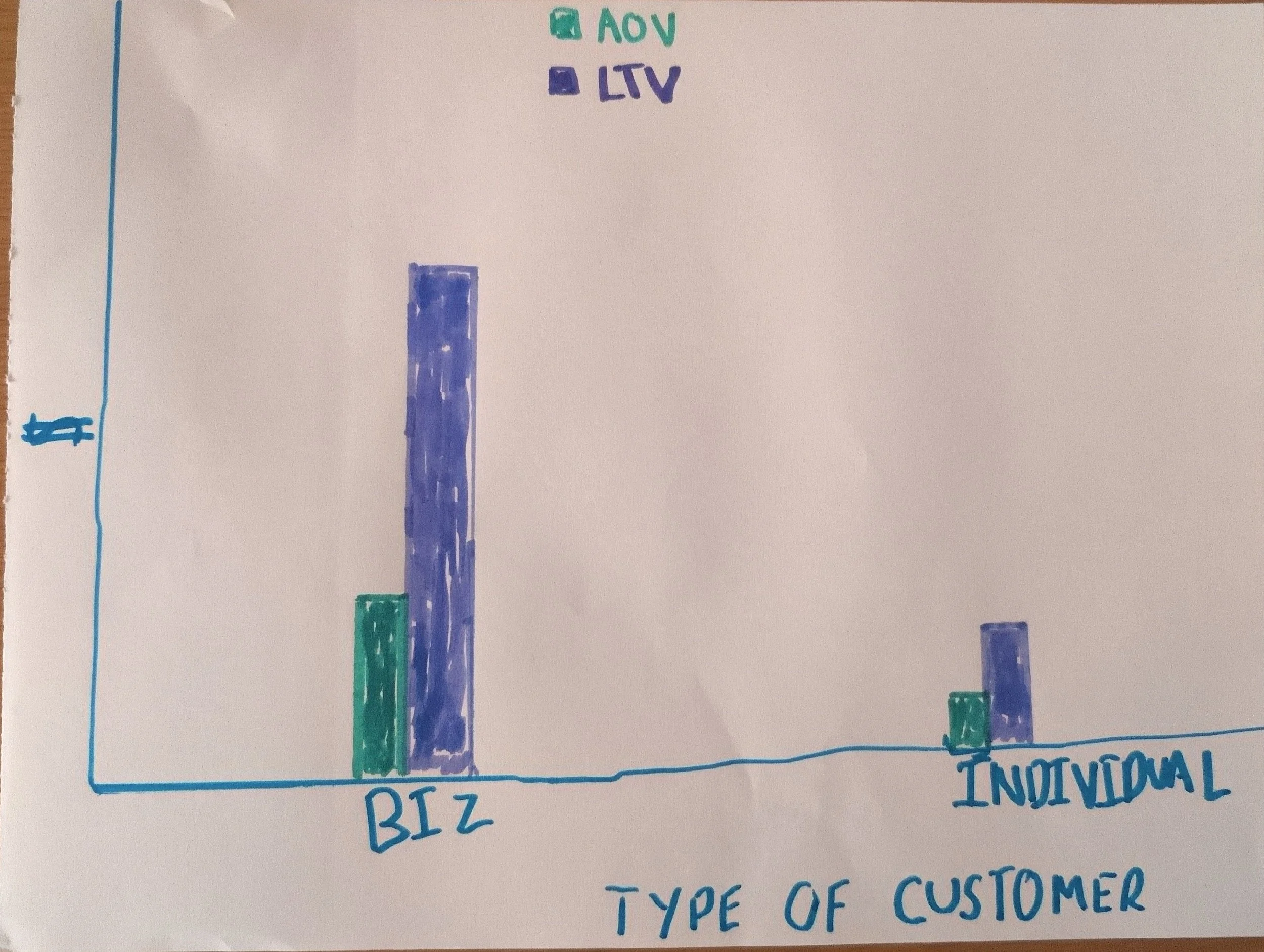
Your Business customers likely have a much higher LTV than your individual consumers.
The Hidden B2B Engine Inside Every D2C Brand
Yep, even if you think you’re D2C. Even if your site doesn’t have a wholesale tab. Even if your entire brand story is about individual consumers. Once a company crosses around $10 million in annual revenue, I’ve seen it again and again: buried in the order history is a small but mighty group of businesses quietly buying over and over and over again. They’re not loud. They don’t ask for discounts. They rarely reach out to customer support. But they are the foundation of predictable, profitable growth.
Finding them is easier than you’d think. Start by pulling up orders with a company name listed in the shipping or billing fields. That’s your first clue. These aren’t impulse buyers, they’re companies purchasing your products in bulk for their own customers, employees, or resale.
Then, look for your serial buyers, the customers who have ordered five, ten, or twenty times. While most people buy once and disappear, these few keep coming back like clockwork. When you see that kind of repeat behavior, there’s something structural behind it.
And if you really want to see who’s driving the bus, look at your outliers. When your average order value is $200, but someone just spent $8,000 or bought 30 of the same item, that’s not a one-off enthusiast. That’s a business customer hiding in plain sight.
What Not to Do Next
This is where most e-commerce teams get it wrong. They discover these business buyers and immediately think, “We should build a B2B portal.” Don’t. That’s how six months and a hundred grand in development vanish without a measurable return. These customers already figured out how to buy from you. They don’t need a login, a dashboard, or another friction point. What they need is a relationship.
Instead of building software, build a connection. Pick up the phone. Ask how they’re using your products. Ask what made them choose you, and how you can make their life easier. You might learn they’re reselling your product, giving it away as part of a corporate program, or using it inside their own manufacturing process. Sometimes you’ll even stumble into a new distribution opportunity you didn’t know existed. But you’ll never know unless you talk to them.
Serve Them Like Partners, Not Promo Codes
Once you know who these businesses are, stop treating them like everyone else. Segment them out of your normal campaigns. They don’t care about “20% off this weekend” or new lifestyle photography. They care about reliability, lead times, delivery options, and stock availability. Change your communication accordingly.
And here’s a surprisingly effective move: send them something physical. Yes, actual mail. A postcard, a catalog, a handwritten note. Everyone’s inbox is a mess, but physical mail still gets noticed, especially by business buyers who open it thinking it might be an invoice. It’s an easy way to stay top of mind without another ignored email.
Most e-commerce directors spend their time chasing new consumers, tweaking ads, or obsessing over funnel metrics. But your fastest path to sustainable, profitable growth might already be right in front of you. Those repeat business customers are steady, loyal, and far less expensive to serve than the constantly shifting consumer base. They don’t need convincing. They don’t care about your latest ad creative. They just need a reliable partner who ships on time and makes it easy to buy again.
Find them. Call them. Learn from them. Serve them like partners. You might realize your most valuable customers were never D2C at all, and once you do, you’ll see your entire business differently.
Need help finding these customers for your store? Drop me a line.
Want more?
Make your job easier, let Mobile1st Grow RPV for you
At Mobile1st, we help e-commerce brands grow revenue per visitor.
We do it by combining customer-first research with testing and experimentation that cuts through the noise of dashboards and opinions. Our team uncovers what really drives purchase decisions, then runs experiments to prove impact — so you can stop guessing and start scaling
Want help? Reach out.
Want to be featured on Checkin to Checkout?
Send an email to justin@mobile1st.com, and we’ll set up a time to get to know you to see if you’re a great fit. We’re always looking for e-commerce leaders to feature on Checkin to Checkout
