
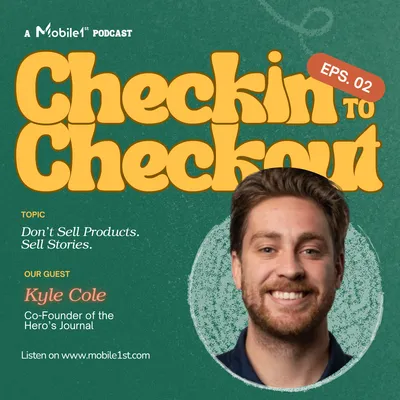
Sell Stories Not Product - Kyle Cole
Most e-commerce stories start with product-market fit.
This one started with Frodo.
On this episode of Check-In to Check-Out, we talk with Kyle Cole, co-founder of The Hero’s Journal—a journaling brand built on the idea that life gets easier when you start seeing yourself as the main character.
What started as a nerdy side project turned into a seven-figure DTC brand powered by story, community, and a refusal to send boring emails.
Kyle opens up about:
-
Accidentally going viral during quarantine with a “Quarantine Quest”
-
Scaling fulfillment from garage to 3PL—and the painful (but hilarious) budget mistake he made
-
What every e-commerce leader gets wrong about community building
-
How to forecast without deluding yourself
-
Why the best marketing emails sometimes have no CTA
If you’ve ever tried to justify a warehouse lease based on “the traffic you're manifesting” or had your team melt down over a 3PL gone rogue, this one’s for you.
It’s funny, vulnerable, and weirdly practical.
And yes, we talk about iOS 14.
Perfect for: Directors of E-Commerce, DTC operators, brand builders who think “community” isn’t just a Slack channel
Listen in and remember: you are the hero. Just maybe... also the operations oracle.
Transcript
Justin Aronstein: Welcome to check in to check out the podcast about E commerce leaders and how they got to where they are and where they think e commerce is headed. On today's episode we have Kyle Cole, co founder of the Hero's Journey. My name is Justin Aronstein and sitting next to me is Connor Burke. We're excited to have you, Connor. How are you doing today?
Connor Burke: I'm doing pretty well, Justin. I'm doing good. How are you doing?
Justin Aronstein: I'm doing great. I love this conversation. It's all about using storytelling to sell. Instead of selling products, sell a story. And it's really based off the Hero's Journey, which is literally my favorite storytelling model from Joseph Campbell. I learned about this in high school and it blew my mind of what a story is that goes all the way from the Norse stories to what you see in Star Trek and Star Wars today. I think this is an amazing episode and I learned a ton of how powerful stories can be in E commerce.
Justin Aronstein: Thank you so much for coming on the show today, Kyle. We're really happy to have you. How you feeling today?
Kyle Cole: I'm feeling good. I'll be honest, this is my first podcast appearance, so I'm feeling pretty good. I'm feeling pretty excited about it, but yeah, good stuff to talk about.
Justin Aronstein: So awesome so far. You're doing great.
Connor Burke: It's one of our first things too. We're just now exploring the podcast space.
Justin Aronstein: So tell us, what do you own at Hero's Journey? What's your day to day look like?
Kyle Cole: Yeah, so I'm very much in charge of the day to day operations. Customer service -- we call it here, I'm going to use the word hero a lot, we call it hero service. I do a lot of the reporting, making sure our ad account is performing well and not just burning money on fire. I make sure our warehouse has everything they need, paying all the bills, talking to our finance team. So I'm kind of just doing all the day to day, in the mud type of things.
Connor Burke: Has there been maybe any highlights of yours this week, or maybe any weird unexpected incidents? Things that don't -- you know?
Kyle Cole: I would say that we work with an ad agency for ad buying and we heard that our ads are performing the best out of all their clients. So that was pretty exciting to hear, because positive ad performance in the modern e commerce space is like finding a unicorn in the forest. Anytime -- I'll take it, I'll take it.
Justin Aronstein: Did they tell you why? Like what they attribute it to?
Kyle Cole: They did not tell us why actually. But you know, it's one of those things where you don't argue with it. You're like, hey, you think I'm pretty? I'll take it. Like, I don't need you to tell me why I'm pretty.
Justin Aronstein: That's awesome. So in terms of all the things that you are dealing with on a day to day, there's some strengths that you have and there's some weaknesses. What do you find that you're best at?
Kyle Cole: Yeah, I definitely thrive in the -- what's the problem, how do we solve that problem. I'm very good at creating an action plan. My co founder jokingly calls me the meeting master, because I'm really good at hosting a meeting, which is a weird thing to be proud of. But I think it's a compliment. It's like how do you enjoy the meeting but also keep the plot right there? You have to have both of those things in tandem. And so yeah, my strength is I'm very much a people person. Helping people feel seen, understood, know what their objectives are, and then having a good time while we do it.
Justin Aronstein: Awesome. And where do you rely on others?
Kyle Cole: I am blind to product details, to be honest. When we first got our samples for our very first product ever, we had three different colors of the same red. And my co founder was like, this one's perfect, these two suck. And I was like, those are all red. Those are the same color. But he has this sixth sense for quality and these really nitty gritty things that just fly over my head. I'm very much like, okay, now we have the thing, let's fulfill it, let's get it out, let's get it moving. And he's like, let's slow down, let's make sure all these details are absolutely perfect. So yeah, I'm jealous of him sometimes for that.
Connor Burke: I'm looking at your product here and I love the concept. My major in college was actually in screenwriting, so I love the Joseph Campbell Hero's Journey. In the role that you play, do you feel like you could be like a character in a fantasy novel? Like the warrior or the wizard or the healer?
Kyle Cole: Yeah, you know, it's funny. We worked with a guy named John for a long time and he gave everyone's departments a fantasy name just because he thought it was fun. So I was the operations oracle. And Nick was the product paladin. But honestly, the origin of the business is very derived in story. My co founder and my best friend and my roommate at the time -- we were all living in a house and he came home to me one day and was like, I have an idea for a nerdy journal. And it was all because he watched Lord of the Rings that weekend. He opened up his journal and was like, why can't I have a journal that also makes me feel like Frodo? Like, why can't I feel like I'm going on this epic quest? Because these goals that I have for myself are like epic quests. These are really difficult things to do. And so we actually found that that narrative arc is what inspires us when we don't want to do what we have to do for our goals. Frodo didn't want to get up. Frodo wanted to have second breakfast or whatever. But Frodo knew the task at hand and went and attacked it.
Connor Burke: That's awesome. Yeah, that really tracks. We talk about that a lot at Mobile First too, that storytelling is a really strong tool that you can use for almost anything. And like to speak to your strength about hosting meetings, it probably is because you have a good understanding of storytelling. That's really what makes those meetings good or enjoyable -- when people can understand how to set things up, how to set an expectation, prove that expectation out, and then allow the attendees to put those pieces together themselves, which is essentially what you do with a good story.
Kyle Cole: Yeah. The other thing on that is a great story -- you never ask yourself why am I hearing this, right? You're just right into it. And so a great story speaks for itself. The worst thing that could ever happen to you in the business world is a meeting that could have been an email. Everyone's experienced that. But a great experience, whether it be goal setting, a meeting, or even a conversation with your friend -- you always know why you're there. And that's the beauty of being able to just take this to level 1000 and make this the most insane story of all time. And you're going to enjoy it.
Justin Aronstein: Awesome. So let's look back on your career a little. How did you get started in E commerce? What's your origin story?
Kyle Cole: Yeah, a bit funny because my life has been very much like -- I will never do this -- and then it's the exact thing that I end up doing. I was a college athlete and I had a fifth year of eligibility and I was like, I don't really want to get another major. So I got my MBA because I was there and they were going to pay for it. I ran track and cross country -- I was one of those guys running around parks in short shorts. And for some reason this MBA program was catered towards small business and entrepreneurship. I remember sitting through this like, this is going to look good on my resume, but I'm never going to run a small business. My goal was I wanted to work at an Amazon or a Microsoft. I grew up in Seattle, so I was in that technical mindset.
I graduated and was having a hard time making the transition to the career world. I got an entry level sales job at Yelp. I started with 80 other people on the same first day. You don't feel very special when there's 80 other people who got the exact same job as you. I was doing that and it was good -- I was learning a lot of good business stuff. But I kind of had this itch in the back of my head like, I need to explore business, whatever that ends up meaning.
So when my business partner came to me with this idea, I was like, okay, this will be the perfect side project. We ran a Kickstarter nine months after the idea was pitched and we raised $15,000. And we were like -- I'll be honest, I was kind of hoping for it to fail, low key, because I was like, I don't know how to ship a product, I don't know how to do any of this stuff. But we started running it on the side. We would get up at 4 in the morning, pack journals, put them in the car at lunch, take them to the post office, ship them out, go back to work, go home. We made $90,000 the first year. We had cleared $150,000 through February of our second year. And we were like, this is making way more money than our day jobs are. So we made the plunge. And now I'm an E Commerce guy. The goal was always just to have a fun story -- and it turned into something I've been doing for the last seven years.
Connor Burke: Do you think if you had a time machine, you could go back and tell yourself something? Is there anything you would do differently?
Kyle Cole: Yeah, there's probably a hundred things I would change. One of the biggest ones -- in the E commerce world there's this thing called a 3PL, a third party logistics partner. They ship your product for you. We were in the middle of our second year, product was scaling super fast, we were running out of garage space to fulfill the journals. And we were like, we'll have so much more time if we just work with a 3PL and they ship the product. We signed up with a very famous 3PL and it went awful. They were sending the wrong products, they were getting destroyed on the way there. The ticketing system was this really archaic model of us being like, hey, we've had 15 tickets this week about journals that exploded. And they were like, yeah, whatever.
Justin Aronstein: But that destroys your brand promise.
Kyle Cole: Yeah. I was spending more time with hero service tickets than I was spending fulfilling journals. But here's the key mistake -- you would think that the 3PL was the key mistake. That's not the key mistake. The key mistake was I took the cost for them to fulfill a journal, and I multiplied that out by the amount of journals that we wanted to sell, and then I created a budget for how expensive our warehouse could be. But the issue was it was the amount of journals that we expected to sell, not the actual amount. I created a scenario where we're saving fake money. There were a lot of nights where I laid awake not knowing how I was going to pay this warehouse bill. Because not only was it super expensive, but we had to hire people to go in there and fulfill the actual journals. That was my don't count the eggs before they hatch moment -- just because you expect to scale this a certain direction doesn't mean it will happen. You have to take real data versus the anticipatory data that you want to have.
Justin Aronstein: Yeah. So when you're forecasting in the future, how are you going to do it differently? Because you're always going to have unknowns.
Kyle Cole: Yeah. The first question is, could I afford it now? Because I think the future of your business looks a lot more like now than it looks like what you want it to be. And it will end up looking like you want it to look, but it's going to look like now for a while, and that's okay. If anyone's trained for a marathon or tried to lose weight or whatever it is -- you have to live with your current form until that form is ready for the future form.
So the first question I ask is, can I afford this today if things didn't get better? The second question is, if things get worse, how am I going to cover this? Do I have a way out of this? And then the last thing is, is this good enough for the best case scenario? You also don't want to have a situation that breaks if things get way better. But the main advice would be: if today was today for a lot of days, would I be able to afford this? That's the moral of the story with pretty much everything.
Justin Aronstein: So it sounds like when you started this, you knew you had a product people were willing to invest in. But growing an E commerce business was new for y'all. Was there anyone that helped guide you along the way?
Kyle Cole: Yeah. We actually hired a CMO who we later had to part ways with. But as an early member of the team, he was massively influential. He was a writer and he was obsessed with the author model of building a business. Think about the guy who wrote Subtle Art of Not Giving a F*ck, or Ryan Holiday -- great authors who also have massive internet brands and don't have to focus on publishers because they can create their own noise.
So he sat down with my business partner and was like, here's what we're going to do for our first Kickstarter. He said, you're going to spend 15 minutes writing a blog. Don't spend any more time than that. And we just put a little bit of money behind it, trying to start building an email list. I wrote like, nine C.S. Lewis quotes I use every day in my sales job -- that was my blog post. We built an email list to about a thousand members on $800 in spend, which was pretty exciting. Didn't know what a good return was, but it didn't feel like a bad one.
He really helped us build the early framework for how we were going to build out our email list and what turned into our community. Because the community has really been the backbone of the business. And then during COVID we did this thing called Quarantine Quest. We really just did it because we thought it was good for the world. People don't know how to have a productive day when they can't go outside -- so we gave people little mini side quests to do while they're in their house, then we created a Facebook community where they can share how they did.
We had 30 members in our Facebook group. In four weeks our group went from 30 members to 10,000 members on about $4,000 in ad spend. We spent about $8,000 over six weeks and our final numbers were 12,000 Facebook members, 40,000 email subscribers. Our whole business changed in a four week span just by live streaming and making little side quests. We went from $90,000 in 2019 to a million in 2020, very much off the back of that insurgence of attention.
Connor Burke: It sounds like you're really flexible, and I think that's maybe a good cornerstone of your business -- that you're very flexible. Being an E comm manager, you need to be able to take a hit and turn and grow from those opportunities.
Kyle Cole: Absolutely. Think about iOS 14 -- that changed the whole ecosystem of E commerce. You just have to be flexible because something like data tracking is just going to change your ability to advertise and it's going to make your business worse even though it's the same business it was the day before. And so you have to be nimble, because if you hold too strong to things, you're going to get lost.
Justin Aronstein: So let's begin to check out and really get onto the next part of your journey. One of the things I want you to teach us is how to use community as a force multiplier for an E comm business.
Kyle Cole: Yeah. This is like my hill that I die on. I think every direct to consumer brand has to have something bigger than the product they sell. Liquid Death is a really great example. The reason we love them is because they took this hardcore metal branding to fight against plastic in the ocean. That's so much bigger than water. And it's something that we can all believe in. When we're buying our Liquid Death cans at the 7-Eleven, we're like, it's a dollar more expensive, but I believe in it.
When you take that thing that people are going to rally around and you create a community of those people and a shared value, that becomes a force multiplier for your mission, which then ultimately your product is a solution to that end. It allows you to really build with conviction and a constant ear to the ground on the actual problem you're solving.
One of the ways we've done it is with Kickstarters. We ran our second Kickstarter not because we had to -- we could have just launched on our website, we probably would have made more money. But we wanted it to be a moment where people could be like, I was here for your first Kickstarter, I'm here for your second Kickstarter. Look at how much we've grown. We ended up raising $303,000 on that second Kickstarter. And we made plushies, maps of a magical school that didn't actually exist, fun items that had nothing to do with journaling but had everything to do with these stories that people loved.
Because the story at the core says that you are a hero. The main character of the journal is named you. They're purposely made this kind of character because everyone should see themselves in the hero. When people are buying these things and putting them on their walls, they're not putting up our story, they're putting up their story.
When you create a community around that, you have people who are buying into that. They're coloring their pages and posting their pages and talking about finishing their Heroes journals. We had somebody who finished 11 Heroes journals, and we were like, that's more than Nick and I have done combined. It really became a community win. And internally I tell people: you could pay your employees with two things. You always have to pay them with money, but you could pay them with more money or you could pay them with more mission. When your people feel the impact of their work on people's lives and they believe in the mission -- that's a form of payment.
I'm really bullish on Skool right now. It's an e-learning platform that has some community features. The reason I like it is because there's not really a feed outside of the communities you're in. When you go on a Facebook group, you're coming off this information highway of toxicity through the timeline. Whereas when you get people into this isolated community on Skool, all they have is the vibe of that place. You're able to hammer in on the actual thing people are trying to do versus the inflammatory things they saw on the way in.
Justin Aronstein: Yeah, that makes sense. So if you're an E comm leader at a company, you sell widget, people are excited -- how do you start exploring if a community is even viable? Where do you begin?
Kyle Cole: Yeah, I would probably start with a focus group. The people that are excited about coming to that are the same people that would be excited about joining a community. You would send an email: hey, thank you so much for ordering the widget, we'd love to get on a user feedback call. And then you'd ask them, what would you want a community to be? How can we make this widget better? And then you would just build it around your personas. The easiest way to get your personas is to already have your marketing personas built out -- or if you don't, just ask the people who use your product, ask them who they are, and then build around that.
Here's my second hill to die on. Signing up for an email newsletter is no longer free. It is one of the most expensive purchases we make as consumers because you get blown up by these brands and you're like, I don't want to see this in my email. When you ask someone to sign up for your email list, you have to give them something really good, because they're giving you their mental clarity. They're giving you space in their email box. If you don't offer something really good, people will sign up, but they'll put you in their junk email, and you'll never actually talk to them anyway.
Justin Aronstein: Are there any emails that you love?
Kyle Cole: I love the Tracksmith emails. I'm very into the ideals of brands. There's the missionary and the mercenary difference in entrepreneurship -- the missionary's purpose for starting a business is to spread their cause, and the mercenary is there to make money. Any brand that sends these idealistic foreshadowings of what your life could look like if you use their product, with beautiful lookbooks and awesome videos -- I love those. Tracksmith's emails are incredible.
And if you're an email manager, just once or twice a month, send an email without a CTA. Just send an email that says: thank you so much for being part of this thing. Take a second, put ROAS aside, and just say, this is why we do this and this is why we love this. We do that probably four or five times a month. And sometimes those emails get the highest return of any of our emails. And there's not even a button on it. I refuse to put a button on them. And it still gets this crazy return -- I don't know how they get to our website from there, but they do.
Connor Burke: I love that. We actually just were reviewing a client's email list and Justin made the exact same recommendation to them -- just showing that lifestyle. It feeds them a little bit of that motivation to go buy. That is really important.
Kyle Cole: Yeah. And then I think the last thing is -- have you guys ever worked with creators who are making brands? One of my best friends plays professional basketball in Portugal and he started a YouTube channel. A year ago I said, hey, man, you've got to make an email list. And he's like, why? I make YouTube videos and Instagram videos, I don't need an email list. No, you need an email list.
On all of his videos, people were asking things like, can you send me your workout routine? I said, turn those things into PDFs, offer them as a lead magnet, and then send a weekly newsletter about everything going on in your life and offer those workouts in that newsletter. He grew his email list to 12,000 people in about six months. He has almost 50,000 subscribers on YouTube and he has 12,000 people on his email list. That's disproportionate -- you should have 200,000 subscribers on YouTube to have that 12,000 on email. But because he had a really good thing to give away, it happened.
Justin Aronstein: Awesome. Is there anything on your reading list, anything that you're really excited about either professionally or personally?
Kyle Cole: Yeah. From an audiobook perspective, I'm working through Dungeon Crawler Carl. It's fiction, it's not going to make you a better e commerce leader, but it's like a video game in your ears. I also just finished a book called Working by Robert Caro -- he wrote the most in-depth biographies of Lyndon B. Johnson, and he just talks about why he does what he does, the passion for research and work. It'll make anyone hyped about any kind of thing they're passionate about. And I'm reading a book by Seth Godin right now called The Practice -- it's all about how in the digital age, you just got to publish, you've got to get your work out there. It's a good inspiration to just hit publish on LinkedIn or wherever you put your content.
Justin Aronstein: And Kyle, if people want to find out more about you, where can they find you?
Kyle Cole: Yeah. If you want to check out the Hero's Journal, it's theheroesjournal.co -- it's a possessive heroes, apostrophe, not a plural. And I'm on LinkedIn if you want to connect there. I also write a newsletter about my experience starting the Heroes Journal and working with my buddy overseas. A lot more just my philosophical ramblings. But yeah, if you want to check that out, that works too.
Justin Aronstein: Awesome. Well, thank you so much for your time, Kyle. This was a ton of fun. And if anyone wants to find us, you can find Connor on LinkedIn, Justin Aronstein on LinkedIn, and we'll be doing more of this, talking to e comm leaders and learning from them. So thank you so much, Kyle. Really appreciate your time.
Kyle Cole: Thanks for having me.