
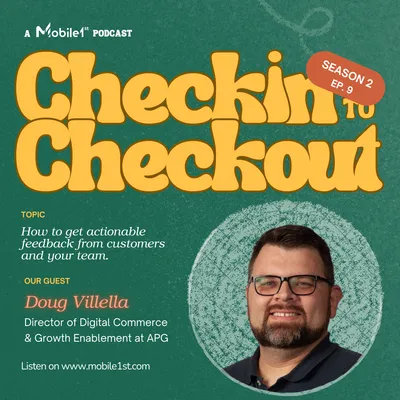
How to get actionable feedback from customers and your team - Doug Villella
In this episode, Doug Filella, Director of Digital Commerce and Growth Enablement at APG, shares insights on building and scaling e-commerce operations within a smaller organization. Topics include operationalizing marketing, leveraging customer feedback, and future trends in e-commerce technology.
Want any help Personalizing Every Customer Touchpoint? Check out https://Mobile1st.com.
Interested in talking to Justin or getting on the show, find him on Linkedin: https://www.linkedin.com/in/justinaronstein/
Insights:
- Building scalable marketing operations
- Operationalizing customer data and feedback
- Future of AI and technology in e-commerce
Transcript
Speaker A: Welcome to Check in to Checkout, the E Commerce Growth podcast for Mobile. First, my name is Justin Ehrenstein and alongside me is my co host, Connor Burke.
Welcome to check in to Check Out. This week we have Doug Valella, who is the Director of Digital Commerce and Growth Enablement at apg.
So, Doug, that's a really long title. Sounds like there's a lot in that. What do you do every day? What do you own? What's that look like?
Speaker B: Yeah, yeah. So thanks for having me. I really appreciate you guys inviting me on the show. I've been listening to the podcast. It's really interesting to hear from all these different leaders. For me. So the title, the Director of Digital Commerce and Growth, it's a big one. I would say that it's because I'm wearing multiple hats. The idea was I was coming in as the director for E. Com. I had been working on a project for APG over the last 11 months or so to stand up this new version of their E. Comm. Experience. And once we were ready to actually launch it, they reached out and said, hey, you know, maybe you're interested in, in coming to work for us to do this, like, to own this thing that you just built. So I came in there and to do that. But one of the things the CEO made really clear was his name's Todd. Todd said very clearly. He's like, I need somebody who is, you know, obsessed with more than just E commerce. Like, I need you to own, you know, our HubSpot relationship. I need you to own the. The relationships with our vendors that, that sell us tech software. So I, I consider myself a product manager as well as a project manager. So those, I mean, they're intertwined, sort of. But I'm also a merchandiser and a marketer, so I, you know, I'm sending campaigns and checking the PDP designs and layouts and things like that. So lots of varied hats, but I think that the title kind of captures as much of that as possible.
Speaker A: So you started an E Commerce kind of org within an existing larger org.
What's that like? And how's that compared to other experiences in your career?
Speaker B: Yeah, that's a great question. So, yeah, working at larger corporations where you've got multiple layers of people, you've got dev teams and QA teams. I'm working on a team of basically three people. It's myself, my lead IT person, who's also one of our developers for our internal systems. And then we have an IT consultant that is overseas. And so it's A. It went from a teams of 20, 30, 40 people that I was, I was managing more, you know, four or five of those working with lots of teams. Now it's, it's very narrow scope of people that I gotta interact with for the technical side of it. But yeah, it's a, it's a very different thing. I mean, I would say that the biggest challenge for me would be that, you know, I, I have expect high expectations having worked for these organizations that are much more evolved and they have, you know, layers of hierarchy around their marketing and their ad campaign people and, and that now it's just me. So it's a, it's a different, it's a different way of thinking about it. But I also think, you know, it scales, it scales for the size of the company. I mean, we're, we're a much smaller organization than, you know, Philips and Unilever and the folks that I've worked with in the past who have tens of thousands of employees and, and I. For a company that's got less than a hundred, so it's a change of perspective. But I also think that expectation helps me to lead by example with the folks that are on my team because they may not have worked with bigger organizations, so they're not sure of what that evolution is supposed to look like. So one of the things that I did when I first started was set up some time with our sales manager or director. Her name's Jana. She spent time with me just going over what we had done with marketing in the past and so on. But I said, you know, one of the things I'm noticing is there is no operation of marketing. It's just we're doing it ad hoc all the time. It's always reactive. And she's like, yeah, it's really hard. And I said, let's, let's think about how we can build a marketing operation together. Because the sooner we can build some, you know, the templates and the designs and the things that we want to do.
I mean, some of that was there, but it wasn't organized. It wasn't set up in a way that we could scale it. So that's, that's what I'm trying to bring to the table is like, what are the things that APG doesn't do today that they can do tomorrow? But we, we have to build the foundation of that in, you know, a marketing operation as well as an E Comm. Organization that, I mean, essentially didn't exist until I started. It's, it's. They built Stuff, but the people who, who all built it way back when, they're no longer around. So it's, it's coming in fresh with new eyes and trying to sell, see, you know, learn about the company. But see where I can, where I can take the next level of growth with this company using online as, as the channel.
Speaker A: So that marketing operation, that's a real problem that companies, e commerce companies from 2 to 20 million have they, they figured out they found something. They, they have something, but it's not always operationalized. So for your team, what were like the first one, two, three steps you took to start to operationalize it? But it's not easy, right?
Speaker B: Oh, no, it's. Especially for a company that didn't have one already. I, I'd say the first thing I needed to understand was like, how we're dealing with customers. And so, I mean, at the very simplest level, like, okay, We've got a CRM. We use HubSpot. How do we use it today? What are the things that we're doing with it? Are we building, are we building relationships? Or is it just a glorified contact system? Like, what is that? And so doing that first evaluation, kind of breaking down the components of what we've got first, and then trying to understand, okay, how can we turn this into a repeatable process or something that is a foundation for what will become a repeatable process. A lot of times it's just, you know, sometimes we start looking into the tools, we start looking into what we've got and go, wow, we have nothing. We're really just building this from the ground up. So, so I, I came into it with an open set of eyes, but I also knew that it was going to take time to build. So it's patience, it's knowing. I mean, that was, that was probably my, my hardest thing to overcome is the speed with which operations typically work is you, you know, you pick your campaigns, you pick your timings, you pick your audience, and then you set up, set it up and go. And now it's like we have to, we have to roll that back and say, okay, how are we defining our customer segments? How are we defining what those campaigns mean? And then when we work with a consultant, there's a company that is helping us with asset management and creation of new content, and they have an operation. So I'm trying to mirror some of the pieces that they have. But right now it's just trying to, like I said, build the structure of the foundation.
Speaker A: Love it. That's an incredible insight because Operationalizing anything is difficult. And how do you not make things just one off for everything? Just like, oh, right, you have this spring campaign, even though you've run the same spring campaign, but every time you look at it, it feels like it's new. It's like, well, it shouldn't have to.
Speaker B: Exactly. We have to have. Yeah, we got to build kind of that input, output part of it. So right now it's basically we're, you know, the input is, we're using basecamp. We're, you know, we're sending the requests over to our team.
But I think the key for us is to really, like I said, breaking down the fundamentals of what it is and then saying, okay, how can we use, what are the tools we have? How can we use those tools? And then how can we turn this into, okay, you know, every time we're going to launch a quarterly campaign, these are the minimum requirements that we start with. And so if we know we're going to launch something for Q2, we need to do, have started last, last month. So we have to have time to plan it all out, identify those audiences, build the campaign structure around that. And then what is the, what's the message? So, I mean, it's funny, it's funny to think about that, but a lot of times, you know, when you're doing it ad hoc, you're thinking about the message first and then the logistics of it later. Now it's like, okay, let's think about the logistics of how do we, how do we make this repeatable? How do we. And it doesn't have to be super complicated because in the end of the, at the end of the day, it's, you know, what is a campaign? Well, it's emails, it's ads, it's social media posts, it's, it's content.
But you have to come around that, that nugget of what the core essence of what you're doing with that campaign, is it to just make awareness or is it to grow? Is it to make revenue or is it to bring onboard new customers? So those pieces are, are critical. But if you, if you're just trying to do it, you know, by the seat of your pants, you're, you're going to end up burning yourself out. So that's why the operations are important. Because when you can essentially, you know, standardize a way of doing something, instead of being reactive to it, you become more, much more proactive. And then the effort feels a lot less strained and anxiety ridden. And it's more about, okay, you know, what are the things we can now play with? What are the A B tests? The dials that we can. Yeah, exactly. What are the dials that we can turn to make this thing better and how do we do it, you know, incrementally? So we're not just doing, you know, here's a big blast of emails or here's a big blast of content and then waiting for something to happen. It's, it's more about now. I mean, especially with, you know, the evolutions of social media and other things. I think if you can't stop and, and think about how our customers interact with us, you're missing the point. And that's, I mean, that's probably the core, the core part of my job is to figure that out and then decide how we're going to move forward with it. But again, aligning with the team, the leaders, everybody who is, who needs to be involved in that so that we're all stepping in the same pace. We're not just, you know, we're not just all flying different directions and doing stuff all kinds of crazy.
Speaker C: Yeah, I, I got a question.
Good to see you, Doug.
Speaker B: Yeah.
Speaker C: I'm fascinated by the fact that while you were doing a project and they took you on and, but your, your, you know, formal employee status is relatively new. How did you go about working with Todd in such a way to say, hey, I'm going to do some, you know, some research and audit and I'm going to spend some time with head of sales, etc.
How are you setting up for success with Todd and the organization for the things that you're doing?
Because our audience is definitely in, in the space, but often in the mix of like three, four years in. But how are you setting up for success?
Speaker B: Ah, that's a great question. So in terms of setting it up for success, so the, I would say the, the most important things to me when I'm building out the plan and doing an audit, I mean, we did, we did the audit back in 2024. Excuse me. The, the biggest key for me is, is having good data to start with. So you have some way that you can measure like what it is, what's good, what's bad and not being able, trying to rose, you know, make everything rose colored or pretty. It's that you're being candid with your, the folks that you're talking to about it and saying, okay, here is what I see. And I mean, I would say, you know, the number one thing that I saw when I, when we did the audit was we weren't tracking any transactional data for our analytics. I mean, we had it. We had transactions in our erp, we had transactions there. But when you're looking at Google Analytics and you're looking at those tools, if you can't see what's actually going through the system, you have no idea what's, what's winning or not. And so that was my first thing I said, before we even touch the website, we need to fix the analytics. We need to get Google Analytics working again. And so that was, that was. The starting point is saying good metrics.
So we know we can, we have a baseline and then we can work with that. We can say, these are, this is where we're at today and this is where we want to get to. So how do, like, where does that come in? But if we don't have a measuring point, a place to start, you can't have success unless you know where you're coming from.
Speaker C: A hundred percent. A hundred percent. So how often do you check in with senior leadership to say, hey, progress will be reporting on a monthly daily.
Speaker B: We actually have a, we have a daily leadership standup meeting with our head of operations, our head of our warehouse, myself, the CEO, head of sales, and the head of our customer support team.
So we, every morning, 9:00am, everybody's sitting on a call. A lot of those, I mean, they probably last 15, 20 minutes at most. But those are where we, we talk about what happened the day before or the week before. We talk about what's coming next or what's bottling us up or what's causing risk now.
So we're, we're spending a lot of time, but it's not a lot of time, but we're spending continuous, repetitive. And again, this is the institutionalizing of, of these processes is that if we're talking about it every day, we're thinking about it every day. And that was, that was a big thing that I think it was hard. It was much harder to do in bigger organizations because I think everybody's already getting pulled in so many directions. There's already so many responsibilities. But you have to prioritize that as part of your strategy in saying that it's more than just, here's the goal, let's go get it. It's, how are we doing, how are we tracking and then seeing that, actually seeing those changes happening and keeping the team informed. Because I think the more people know what's going on and more connected they feel to it, the more they're going to Want to engage when you have to ask for help or you need their support. So if you're, if you're some guy, you know, and I mean, I'm a remote employee. I've been doing this for almost 10 years now. Remote.
It's hard when you're not face to face with people to actually get their attention.
So that's, that's my, my thing is really, if I, if I'm over communicating, then I'm doing my job right. If I'm not communicating enough, that's the number one failure for me is if I'm not keeping up with the, the communications and what's going on with everybody else as well.
Speaker C: That's great, great advice, great insights and really reduces, you know, the big fire drills or things like that. We had no idea you were doing this. Well, that, that you just take that off the table.
Speaker B: Yep, exactly. Yep. We're talking about it every day.
Speaker A: Do you have a daily stand up. It sounds like you have a daily standup with kind of the up level or maybe peers. Do you also have a daily standup with the team that reports to.
Speaker B: Yes. Yeah. So the IT folks and the development team. Yes, absolutely.
We spend at least half an hour every day talking about what we got done, what's next in the sprint, what's the critical priorities. And sometimes those conversations go sideways because we realize something broke or we have to, you know, there's a request from somebody or we, we noticed there was a bug somewhere. Those conversations can happen. But when you're having those daily conversations, you can overcome that. You're not waiting until the next weekly call to get caught up. We actually can, we can pivot and being small, we can pivot a little faster than, you know, if you're dealing with four layers of management to make a decision. So yeah.
Speaker A: Within your team, sounds like you have a development team and IT team. How much of your team is focused on traffic acquisition versus development? What's. What's kind of that?
Speaker B: That's a good question. So I am, I'm probably the sole person that is trying to drive traffic within my team. My job as the person who is in charge of growth and marketing, I have to be primarily focused on what is bringing our audience and what is keeping them there. From the IT development side, those guys are really more worried about the technological data. You know, is the data flowing correctly or the system still up kind of thing. Is the code still working? Is the pricing still being displayed? I have to again, because I'm responsible for that. I have to lead that conversation. But I also, then I know that I'm not the only person who is touching base with our customers. So I have a monthly call with all of our outside salespeople, and we talk about the leads that are coming from the website. We talk about the leads that are coming from. We have a piece of software called Factors AI that helps us identify those. Those customers or the companies that visit our website. And that's been really helpful because now I have reports that I can give to each one of the regional managers and say, here's your manager. You know, here, here. Northwest manager. This is what's going on with you, with your customers, who is on the site this week. How many of those were submitting, quote requests or, you know, buying stuff? And so they get a personalized set of data for them. And that was. That was also one of my goals is that, you know, it's a small enough organization. We should be able to have personalized reporting. And so that was something that I, you know, I spent a lot of time with my sales team, you know, asking them questions about how they do their jobs, what's important to them, and then translating that into a report, something that they can consume and is useful for them. That's always the conversation we have, is, how useful is this for you? Is it helping? Is it making it better?
Because I don't want to just, you know, throw data at them and then say, okay, go do your jobs. I want to know, is it. Is it actually making a difference? And if it isn't, what can we do to change that? So it's. It's less about just numbers and more of, again, the people and understanding what is important for them. What is the value that they want us to bring?
Speaker A: Totally. So I have a question that's actually for myself because I'll send reports to either my team or clients and I'll ask them, did you open this?
Did you look at it?
And I swear, nine times out of ten, they're like, oh, yeah, I didn't have a chance to look at it. How do you overcome that problem?
Speaker B: It's again, the over communication. It's really. It's saying, hey, hey, here's this report. But also asking them to say, okay, and giving them a to do, giving them something that they have to. Or that they should respond back to me or at least to their boss about what that report means to them. So that was one of the. That was one of the parts of that value message to them, too, is to say, it's not just that you're getting new sales. I mean, salespeople, that's what they care about. They care about growth in sales, but it's also about, are you nurturing those relationships? And so when we, when I can point to a report that says, okay, this customer's been on our website 50 times this week. They were looking at these 20 products.
Have you contacted them about it? I mean, if I just ask yes or no questions, I'm going to get a yes or a no. But if I, if I, if I can frame that question in more of a way that actually makes them think or it makes them realize that there is more to it than a yes or no, then they actually start thinking about it. So it's, it's, I'd say it's a learning process. It has, it didn't happen overnight. I want to say it probably took about three or four months for the sales team to really kind of get the gist of.
I'm not just doing this for fun. I'm not just throwing you reports for data. I really need, I really want you to engage with it. And so I want like. And that's, and so I, you know, again, it's the curiosity coming back around. It's, if you can't, if you can't be curious about it, you're going to get lax about with it. And that's, that's the end of it for me, is we can't get, we can't get lazy. We gotta, we gotta think about different ways of connecting to our customers because the better we connect to them, the more likely they're gonna sell because they trust us. So that's, that's a key for me. Is, is no. And so there's a salesperson mindset. When I was at Unilever, I was technically a salesperson. Even though I was responsible for E Comm, I was a sales guy. So I had, I called on Amazon, I called on other companies, but so that salesperson never kind of went away. But now it's back to marketing and growing and thinking about how to develop new leads and new relationships.
Speaker A: I love it. So one thing you mentioned, on your team, you're the only one driving traffic and you have a couple people, three, four people managing the development.
That is the opposite of most teams we talk about in terms of time and treasure, talent, treasure working towards acquisition versus conversion. Why are you set up like that? What are you focusing on? How does that work?
Speaker B: Yeah, that's a great question. I would say right now my biggest focus is on simply just awareness and bringing people to the site to see it.
So that's the campaigns that we're running right now. We are trying to showcase the new features and the new systems that we built to make the site easier to use for our customers. But it's really breaking it down to the most fundamental nuggets of. It's helping. This will help you reorder faster or find your products faster, or this will allow you to filter down the results that you're looking for. So, apg, I didn't really talk about what we sell.
So the majority of what we sell is O rings. I mean, you think about, you think about O rings. Well, everybody uses O rings. You don't realize how prevalent they are in everyday life. They are in everything. They're in your phone, they're in your, you know, laptop. They're everywhere. So not just tech, but, you know, industrial stuff. So when I think about what we sell, I have to think about what are the. How are our customers looking to find them. And so when I look at our competitors, so there's a bunch of competitors. I mean, O rings are so commoditized. Everybody sells them. We, we, you know, trying to, people, people trying to sell us from China and from other countries even.
But there's some really great competitors out there that I'm taking examples from because they look at how their audience searches on their website and so they build configurators or they build certain filters in certain ways with certain visuals. And I'm taking all of that in because I want us to, I don't want us to mirror that perfectly. I mean, what's the point if we're, if we all look the same, who's making the decision? It's based on price, then? And it shouldn't be just about price. It should be about the quality of the product. That should be about how it solves the problems that they, you know, that they're trying to solve. So that's where I'm trying to take it is, you know, again, we're starting from a very early place right now. But the evolution that I see happening is as we evolve our product data and we get more sophisticated in our PIM and the way that we use that, we're going to be able to start layering in. Not just here's an O ring, this is the size, this is the material, or this is the durometer. That's a, you know, that's an attribute that has to do with the hardness of the rubber or the silicone. I'm More concerned with how can I make it easier for you to find that product, number one. But then number two is what are other problems that this thing could solve or that we could find? We could use these tools to help you find other things. Because a lot of times if they're buying O rings, they might be buying custom made things or they might need them customized for their organization.
Like we'll sell vulcanized rubber and we treat it, we actually have a treat heat treatment system in our warehouse to do that. So we can customize custom length, size, all that. So it's, it's really again, listening to the customer, what they need and then translating that into an offer. Something that, that, that resonates with them.
Speaker C: Yeah, they're differentiated value.
Speaker B: Yeah. Yep, yep. So it's not just price. If it's not just price, you're going to be playing the race to the bottom. And that, that was always my challenge with Amazon is I always felt like they were pushing that. Every time I talked to them, they're like, well, you know, we need to lower the price. And it's not about just the price. It's more the, it's more about the product and what it means.
Speaker C: Price is what you pay, value is what you get.
Speaker B: Yeah, yep. Absolutely.
Speaker C: Yeah.
Speaker B: Good.
Speaker C: Bottom up. It's good.
Speaker A: So you talked about listening to the customer. You probably have also how to talk to your team to understand this product. You're coming in selling something that you haven't been in this industry before. So what's your process from like talking to the customer, learning from the customer, learning from your team to really understand how to solve these different problems.
Speaker B: Yeah, so I try to have, so we talked about touch points with leadership and we talked about, about, you know, touch points with my team. But I also schedule time with people on the inside, like our inside salespeople or warehouse people. I've been. When I actually had a chance to go down to Houston a couple of weeks ago and I met this guy and he's been working for the company for 40 years. He's literally been there through five CEOs. All of the transitions, he's worked in the warehouse. He's now a sales, he's an inside sales guy and he loves what he does. He, he is probably one of the best O ring specialists I've ever met. This guy could tell you our product numbers from memory. Like he's like, look at, you know, let's find this on the website. And he's like, tell me what's going on with this product. And we'll look at. And he's just rattling it off. And so I schedule time with them. I spend, I like. His name's Eugene. Eugene is a, like I said, he's been there forever, but he's like a fountain of information.
And that's all institutional knowledge. I want to, I want to capture as much of that as I can because the minute he retires, all of that goes out the door with him because it's all in his brain. So I want to try to get as much of that out of his brain and into, you know, our PDPs and the products that we're selling. Because he knows how to talk to his customers and how to translate that into a sale. So I schedule time with him. So I do, I try to do at least like a monthly check in. But I think I'm going to probably kick that up a notch because now that we're focusing on PDP content is a big thing. Focus. Right now I want, I want his input. I want to know how I can write better descriptions and better information about these products.
So, you know, touch points with the inside team as well as touch points with the customers. So one of the things that I was really adamant about when I was doing the audit is I wanted to hear from customers that use the website every day. And so I've actually got a couple of customers that I'm still talking to now that I was talking to a year ago that send me feedback and because I, I sit and I listen to them and I hear what they say and I tell them, you know, okay, this is a great idea. This is something we can do, or this is why we did it this way. Does it make more like, would it make more sense to do it the way that you're talking about? And a lot of times more often than not, they're right because I don't know anything about it. And the second is like, they're not the only customer that is trying to search for or trying to use our products in those ways. So again, it's a universal type product. But every customer app, you know, how they're applying it and using it is different, but there's still a common, a common thread that, you know, they want, they want to know that what they order is what they're getting. They're going to get it on time, they're going to. And so anything I can do with the website that is going to supplement and support them so they can go find their tracking numbers, so they can go find that information that was something they couldn't do before.
So now we, we've got, you know, order not only just order history but you can see where it was when it was shipped. You got tracking numbers at your fingertips. So those and we, we call that our customer portal. But it's really just like, it's what I thought as the base minimum that you should have for customers on a website. Like if I order something I should be able to see what I ordered and when it's going to come. That's the common thread with Amazon and everybody else. So why don't we have that? So that was, that was another piece that I was like really adamant about was we have to have a self service portal that customers can find their own information. They shouldn't have to pick up the phone. And I laugh because our website is callapg.com they picked that domain name years and years and years ago. And I laugh now because I'm like, we don't really want them to call us right now. We want them to use the tools that are there instead of picking up the phone because that's just tying up our phone lines when they probably could find 90% of what they're looking for just going the, going to the site. So that's the key is think connecting to the customers, connecting to the inside people as well. So that I'm not, I would be remiss if I didn't try to capture some of that knowledge because it's, there's so much that I don't know yet and I'm, I'm learning but I'm also, I'm, I'm gathering it as I'm going and so that's going to become, you know, this will be the next evolution of APG is that we're less about just products and more about meeting the need and what, you know, what that means to the customer.
Speaker C: Yeah, I would get on it right now. APG.com is available.
Speaker B: Yeah, I go grab it, call APG. Yeah. APG is it? Oh yeah, that was, it is.
Speaker C: If you wanted to pivot it, I
Speaker A: would just buy it.
Speaker B: That's a good call. Yeah, I mean that, yeah. Let me actually, I'm going to make a note of that now.
Speaker C: That seems like really smart.
Speaker A: Okay.
Speaker B: Yeah, absolutely.
Love it. APG.com. all right, so I'm getting invite. So here I'm learning, I'm learning right now. We'll send the invoice while we're talking.
Speaker A: So I, I, I love constantly getting feedback and having those scheduled touch points. Do you have scheduled touch points with customers as well?
Speaker B: Yes. So, yeah, like I said, those customers that are in constant contact with, I, I schedule time with them about once every other week. We spend 15, 20 minutes just talking about how are things going, you having any issues? What's been the biggest struggle that you've had over the last week? Using the website? Because sometimes that's what it is, but a lot of times it's just hearing that like by, by me making that connection. The customers always seem to be a lot more forthcoming with the negative stuff as well as the positive. And they're, and they're going to spend time, they're actually going to, they feel valued when they're, when we're listening to them and spending time and they see the change. Yeah. And the more I can, the more I can, you know, keep those moving. So, you know, I've got my core customers that I talk to now. I don't want those to be the only guys that I'm talking to. So I have to kind of rotate in one or two more. So I like, I would say my goal is to try to talk to at least five customers a month. So one a week. Different, different customer each week. Sometimes I do better than that, sometimes I don't. But it just depends on the criticality of issues. But I think like if building a regular schedule of that. So you've got your executive layer, you've got your inside layer and your customers, each of those three have different needs and different things they want to talk about. But it is imperative that you have as a product manager that you're listening. If you can't listen to your customers, you're not doing your job.
Speaker A: I love it. I completely agree.
That's some really good positive stuff. Is there any part of the job that you dread?
Speaker B: That is a great question in terms of dread. So I have to look at my notes. Cause I, I wrote a, I actually, I went through and wrote out a bunch of, you know, answers and things.
But I would say my biggest, my biggest dread is honestly, it's having to wait. I am a very go move kind of guy and having just like, okay, this is going to take some time. It's going to take a couple of days to uncover and fix.
And because I'm not the developer, I'm not the guy with hands on code, I have to, I have to trust other people. And so, I mean that was a struggle at first, but it's still that the dread is there of like, oh man, now I gotta wait two More days to find out if this thing's gonna work or if it's not. And then we have to pivot if it doesn't. And so those, those moments of, you know, we're gonna have to wait for something to happen. And that's probably the hardest part.
But it is a curse of being in a hands on role. Like if you're working hands on, you have to be patient. And so that's the part that I dread the most. But I would say that's probably the only thing that I dread in this role. So it's, and it's not a bad thing, it's just, it's just having to learn patience.
Speaker A: Don't take my advice in this and make sure your developers don't hear this, but download cursor, download your code base and git Claude code. Just working on your code base and cursor and, and you don't have to wait anymore. Like you can just do it all your time.
Speaker B: It's instant. Yeah, yeah, yeah, it's, it's funny. We, you know, we're talking about AI and tools like that. That is something that we, as a company, we had. I literally, you know, before I got on this podcast, I was having a conversation with my CEO about exactly that. If we're going to go dive into AI, I mean, right now we're using Algolia, which is the new search engine that we got, which has an AI component to it and it does some interesting things with personalization and that's great, but we're talking about the day to day operations and how can we, you know, how can we do quotes faster, how can we turn around the calls faster and so on. So we're already thinking about it, but it's, it's a matter of what is the, what is the value and what, what are we trying to accomplish. Like if you, if you just say, well, we need AI. I've had, I've heard that so many times. Like, well, for what, what do you need it for?
If you don't have that answer, we're, you need to actually get that first. That's part of building a good strategy is saying we have a reason. Not just because it's a buzzword or because it's new, but you're right. Like the, the tools though, like Claude and Gemini are, they're so much more powerful than they were even a year ago. I find myself, you know, relying on it for inspiration. I use, I use AI a lot to just like help me figure out how to like analyze Data, like copying. Like, I love that you can just like copy pages from like analytic Google Analytics and just say like, tell me what's going on with this. That has, that has opened my eyes to so many more things than I would have been able to even see two years ago. It's. The tools are there. It's just a matter of how do you, like, how do you use them and what's the best way.
Speaker A: Yeah, so two things on that. It's completely life changing. The one, my favorite thing to do is like, hey, here's my thinking. What are my blind spots? Like, what am I completely missing? Like, what's the other one? And the other one. I'm sure you know this, Doug, but for our listeners, like you can do a workshop of like, hey, what are your processes? And like list all the things that you do every day. What, what takes you a while. What's manual. What parts of your job do you enjoy? Which parts of your job do you dread? And then that overlap of like not wanting to do it and it takes a while. That's where AI should be.
Speaker B: Like, absolutely.
Speaker A: You don't want AI doing creative things that you enjoy.
Speaker B: I love overlap. Yeah, I mean that's, it's like, I mean those are the old school. You know, you build your, your, your, your SWAT or whatever, your SWAT matrix and your, I mean, but it's, it's really, it. What's interesting, I love the way you frame that up too is because you, you can just tell it in natural language. You can brain dump into these things and say, here is everything.
Now help me organize this and make it something that's, that's usable and that is where it's. The power is, is. And like you said too is those pieces that are not, you know, that are painful and they take a long time, but you have to do them. That's where AI is so useful. Absolutely.
Speaker C: So I got a question regarding E commerce.
Where do you see like the next, you know, evolution of E commerce? Like you're, you're in it every day. You're. Yeah, you're, it's fresh for you. So like, what do you see as. Despite the impatience that you wish it now, but like what do you see coming down the.
Speaker B: Yeah, I would say, I mean in like the broader marketplace of E commerce, like, like technology wise, it can be,
Speaker C: it could be things that you're applying or you don't have to be a visionary of like the whole industry, but like for you, E commerce, you're building this. What do you see? Like for either APG or the, you know, your, your.
Speaker B: Yeah, yeah, that's a great. Yeah. And, and I would say, you know, back to the AI question, I think one of the things that APG is going to be struggling with, but I think it's possible is that if we can get our CRM data cleaned up, that's a whole other topic. But if we can get our CRM data to where it needs to be and it's integrated correctly with our ERP system so all of the customer records match. Once that's in place, we'll be able to then start using, you know, AI chatbot tools or things that can help customers also interact with us without having to pick up the phone or send an email. They can go to the website, they can chat with a bot, they can get support, or it can even create tickets and then have somebody call them back or something. I think if we can find a way to implement something like that, that's where I would see a good value and a good customer experience. But I also think in terms of where the evolution of E comm is for APG specifically, one of the things that I pointed out in our audit was, I mean, APG runs lean. So trying to outsource all of our, you know, all of our composable pieces to external companies just wasn't. It wasn't the right move. Because I think if we were trying to bring in consultants who weren't familiar with our business and the way that we do business, it would. It's trying to teach them six years of institutional knowledge in three weeks while they're doing their requirements gathering. And a lot of times it's best to actually have the people who are the experts so the Eugene, come sit in the table and actually talk about this is how my customers buy stuff and this is how they want to find stuff, or this is the, this is the challenge that they tell me about every single day. Having someone voice that who isn't a tech expert can help you really quickly prioritize what's going to happen next. So with Eugene specifically, what I want to do again, content wise is I need to understand those, like, what are the things about the descriptions or the product data that is going to really nail the sale with our customer. And for him, it's, you know, he's got all kinds of opinions, but I think it's trying to get him to the core essence of what can we do with E commerce and how do we then turn that on? How do we, how do we get that into the Customers into the customer's hands and let them play with it. And we've got some, we got some interesting ideas but I think where it's going to go is right now we're using a nopcommerce backend for the or. That's the, that's the, the shop layer and nopcommerce. I don't know if you're familiar with that technology. It's not, it's not a very popular one but it's built on Windows or it's built In, I'm sorry, it's.net uses SQL, so it uses all the same sort of query languages and things like that, but it's essentially open source so you're not paying for the code necessari.
I would say the evolution for APG in the next three to five years would be to move something more cloud based into a more composable set. Right now, I mean technically we are composable. We've got CRM and HubSpot, we've got knob commerce, we've got, they're all hosted in different places. But I would say again, you know, getting back to the core essence of E Comm is what are the things that are going to work for us for apg? And that's really, you know, I think Shopify and Marketo, like all of the different technologies that are out there are great but I don't think they're tailored to work with a B2B company in the industrial manufacturing space. Like they're really their lowest common denominator. Consumer sales.
Speaker A: Definitely.
Speaker C: It seems like it requires discipline to be weary of the shiny object and the application. As you said on AI. Yeah the, you know, either cynical or skeptical in a way it's like, yeah, like you said before, we need AI.
Speaker A: Really?
Speaker B: Yeah.
Speaker C: Where before we go down that rabbit hole, are we really solving customers problems now?
Speaker B: And that applies to all of it. That applies to PIMs, CRMs, dams, everything that you're going to implement in the site or in the space. You have to really understand not only what it's supposed to be doing, but where you want it to go because the technology's there. But it's only going to be good for you if you can then tweak it and make it your own. But it has to be tweakable. It has to be something that you can configure. Especially in a space where we have like custom ERP stuff and all of that. You have to be really skeptical. You can't just, you know, oh, squirrel, that's this is a great, let's go after this thing next. It's, it's not like that. You have to say, okay, you know, I like the idea but why, why are we saying this is a better thing for us? And then once you get to the heart of the matter, you're like, well, we just needed, we just needed better image hosting or we needed better search engine or whatever. And it's like, okay, those are things we can work with without having to burn the system to the ground and rebuild it from scratch again. Like that's, that was my biggest worry is that was where I thought they wanted to go was to, you know, burn everything down, reset it. And I said, you're, you're going to spend a whole lot of money and you're going to hate it because it's going to cost a lot of money and it's not going to be any better than what you got already. So let's make what you got better and more flexible than and scalable than what you've got today. And so that was why we stuck with knock commerce.
Speaker C: Keep optimizing.
Speaker B: Yeah, yeah. Until you can. And that's why I said like three to five years. Yeah, we'll start probably moving to cloud hosted stuff a little bit more and all that. But right now it's, you know, nopCommerce is hosted on an AWS server somewhere. But it is a, it, it isn't what I would call cloud optimized. It's, it's very much a single install. It's our install. There isn't any, you know, backend developers sending us updates anytime soon. We have to, we have to apply those updates ourselves. So again, you know, where do we want to spend our time? Do we want to spend our time tweaking design and making the system faster or better or do we want to make it better for the customer? Because that's really where the answer. That's what you should be asking yourself every time. Yep.
Speaker A: I love it. I've been given the nickname the Destroyer who just likes to burn everything down and then bring it back up. So I, I totally appreciate your perspective.
I, I love to replace things.
Speaker B: Yeah.
Speaker A: I've had both positive and you outline
Speaker B: it can go either way. It can, it can absolutely go either way.
Speaker A: Yeah.
Speaker B: So that's awesome.
Speaker A: So to wrap up, what are you listening to reading in your life? E Commerce. What, what kind of interests you right now?
Speaker B: Oh yeah. So the, the things that are interesting me right now is again, you know, I'll keep coming Back to the core essence of what I think I'm here to do is to, you know, connect with people.
I'm reading a lot about just, you know, how to build better relationships.
There's actually a podcast that I've been listening to for a long time. It's a guy named Rob Dial, uh, it's called Mindset Mentor. And one of the things that he's really adamant about is that you, everybody has the, the opportunity to make their lives better, but it's really being able to break down and focus on what's important to you and, and reevaluating that. It's not a once and done kind of thing. So I, I would say that the biggest things right now for me are building better relationships, building a better mindset for those relationships, and being able to say, how can I ensure that I'm not going to damage or damage trust with people by saying the wrong thing. I talk a lot. I'm sure you can tell I talk a lot. But I also think that it's important that if we can, if we can connect with people on more than a surface level, that's really where the insights are going to come from. It has to be beyond the surface level.
Speaker A: Love that.
Completely agree.
Awesome. Well, thank you so much, Doug. Where can people find you in case they want to connect with you and maybe have a more in depth conversation?
Speaker B: Yeah, absolutely. So I am on LinkedIn. You can find me Doug Valella. If you look up, if you look up my name there, you'll find me. I am also, I have a podcast on opentodiscussion.com I've had that one for a while. It's been a while since I've updated it though. So if you find me on Spotify, it's been a while since I posted anything, but I'm also going to be.
There's, I want to say it's a.
What is it networking? No, it's, it's AI. It's Data center. Sorry, there's Data Center World coming up next, next month and we're going to be, we're going to be having a booth there. So APG is going to be around.
We're going to be trying to, you know, get into that marketplace a little bit more. So. O rings again, you know, O rings are universal data centers and cooling systems and AC&H vac and all that. There's, there's sealants everywhere, so doing that. But yeah, if you want to find me on LinkedIn, that's probably the best place to, to reach out.
Speaker A: Where is the conference?
Speaker B: Off the top of my head, I can't remember. Sorry, I didn't. Yep. Yeah, I mean, I have it in my email somewhere, but my brain is really good at erasing things if they're not directly in front of me, so I can forget quickly. Quickly on those sometimes.
Speaker C: Doug, it was a pleasure.
Speaker B: Absolutely. So much for coming on.
Speaker A: Really great insights. Appreciate your time.
Speaker B: Yeah, no, appreciate it. Thanks for. Thanks for the feedback, and I appreciate the time.