
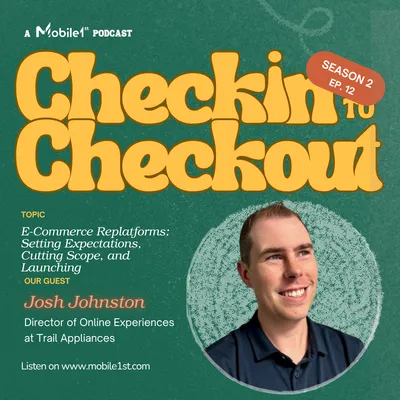
E-commerce Replatforms: Setting Expectations, Cutting Scope, and Launching - Josh Johnston
Josh Johnston has replatformed more than once. He's survived the executive pressure, the scope creep, the SI promises that don't hold, and the promotions engine that no out-of-the-box platform can actually handle. Now, as Senior Director of Online Experience at Trail Appliances — a 50-year-old appliance retailer operating across two branches in Western Canada — he's just completed what he calls the smoothest replatform of his career. Full composable rebuild. Twelve months. Under budget.
But the replatform is just the backdrop.
What Josh really came to talk about is the evolution of the e-commerce leadership role itself — why directors who stay in their lane are becoming obsolete, how to weaponize customer data in executive forums, and what it actually takes to get a CFO to fund something they don't understand yet.
We also get into Trail's AI-powered live chat widget that drove a 4x conversion lift, Josh's vision for how LLMs will reconstruct personalized storefronts in the next 36 months, and why composable architecture isn't just a tech decision — it's how you stay ready for what's coming.
If you're a Director of E-Commerce who's been asked to do more with less, report to people who don't understand your world, or justify investment in things that won't pay back for six months — this one's for you.
Want any help Personalizing Every Customer Touchpoint?
Check out https://Mobile1st.com
Interested in talking to Justin or getting on the show, find him on Linkedin: https://www.linkedin.com/in/justinaronstein/
Key Topics:
- Why the e-commerce director role is becoming a cross-functional leadership role — and what happens to directors who don't make that shift
- How to "weaponize" customer data and bring insights to executive forums in a way that actually moves decisions
- Building the CFO relationship before you need it — and why being proactive beats being reactive every time
- The holy trinity of evidence: GA data + customer chat logs + session recordings, and how to use them together to get buy-in fast
- Trail's composable rebuild: Commerce Tools, Builder IO, Algolia, NuxtVue — why they made the calls they did and what they'd do differently
- How to manage a replatform without blowing your timeline, budget, or executive trust (including the "minefield" framework for contingency planning)
- Trail's AI chat widget: 4x conversion lift, what it does, and why Josh believes humans aren't going anywhere in high-consideration purchases
- The future of personalized e-commerce: how LLMs will reconstruct storefronts based on user history — and why your architecture today determines your readiness for that world
- Managing a shared e-commerce function across two distinct business units with different pricing, promotions, and go-to-market strategies
- Why appliance retail is where furniture was 10 years ago — and the opportunity that creates for brands willing to invest in elevated digital experiences
- Onsite experimentation: where Trail is today, what Josh is skeptical about in CRO culture, and the hire he's making to do it right
Transcript
Justin Aronstein (00:00) Welcome to Check In to Check Out. This week we have Josh Johnston, Senior Director of Online Experiences at Trail Appliances. Thanks for coming on the show, Josh. Quickly, what does that title mean? What do do every day?
Josh Johnston (00:16) Yeah, appreciate you guys having me on. I get this question a lot. What is, you know, senior director of online experience really mean in practice? At trail, that means essentially owning e-commerce, but I'd say more of a focus as well on the site experience, given the long path to purchase that a customer has when buying a major appliance. So for trail in particular, and there's some dynamics to the business. Let's quickly cover off the top. 50-year-old appliance retailer out of Western Canada. There's two branches to our operation, one based out of Calgary, Alberta, and one based out of Richmond, British Columbia. Same family operates the business, but they have different approaches in terms of their go-to-market strategies. So different pricing, different promotions. You can see how this ties into e-commerce, which is a shared service between both branches of the business. But on the BC side in particular, if you came into our trail appliances showrooms, it's almost like going into a high-end car dealership. It's a very elevated experience. The appliances work, so you can go in and actually see them in action. But there's a lot of pride put into that showroom experience. And so for us on the online side, it's been four years, but when I first stepped into the role, there was a lot of focus on like, how do we translate what we're doing so well in store into the digital space? And yes, we want you to drive online growth and sales, but we don't want to lose sight of the aesthetic experience component of all this. So that was where the vision of, rather than senior director of e-commerce, we want to incorporate online experience as well. That's where that came from.
Justin Aronstein (01:59) And so do you own traffic driving as well as conversion and retention as part of...
Josh Johnston (02:04) Kind of. This is where it gets a bit messy. So you've got the Alberta business, you got the BC business. There's two marketing teams that we work very closely with. Ultimately, they're responsible for traffic, but given the nature of the fact that we own the tech stack, obviously thinking from an SEO perspective, there's a lot that we're doing that contributes to traffic as well. So it's a bit of a shared metric, I'd say.
Justin Aronstein (02:24) Okay.
Josh Johnston (02:30) It is unique compared to other environments I've worked at where you do have that ownership. So we're fortunate that we've got two really good marketing leaders, and Bree and Sean, that we can work with collectively. We're aligned on making sure we're pushing in the right direction to get the traffic we need. And then obviously for us to make sure we're converting that traffic as best we can once it arrives.
Justin Aronstein (02:51) That setup is so common in legacy organizations that had marketing before online. in, in the, like are those marketing leaders, because it's an organization that existed before e-commerce, before there was PPC, Google shopping, et cetera, social, how have they been adapting to that, a new wave?
Josh Johnston (03:14) Yeah, I would say it's an evolution. The other challenge we have on the trail side is we're heavily co-op funded. So we also have the needs of our suppliers that we have to work with as well. But generally speaking, I would say from a marketing leadership standpoint, it hasn't been a challenge. mean, we all recognize where the customer journey starts and the type of experience required in order to get that customer to the site. There's still work I'd say we need to do on the tech stack side to nurture those leads better. One of the interesting dynamics of my role, we actually have the live chat team, which is kind of also like a customer support team, although not completely. They can play a role in that as well in terms of, know, legit abandoned card emails that we can actually email you. Okay, and we can help you out with this purchase, but... There is like, we don't have a strong CRM at the moment. That's something that's on the docket, no CDP. So when you're looking at, okay, we got the customer to the site, we saw some good engagement, how do we continue that journey forward? That's really the next step for us and the next evolution that's going to unlock more, not just for our team, but the marketing teams as well.
Justin Aronstein (04:25) And what
Josh Johnston (04:27) Yeah, so I think we're up to 21 now. So we've got the live chat team and a manager that manages that group and they're responsible for driving their own sales as well as upselling customers after they've made a purchase. One of the things we find in the appliance space, oftentimes customers are, you you've got the, okay, my dishwasher broke and I need one ASAP. The online customer tends to be more value focused. So it's like, ah, this, I'm not going to disparage any of the brands we carry here, but there's this entry level product that should be sufficient to meet my needs. It matches my dimensions. Add to cart off we go. Our team of appliance experts, they'll look at that and they'll go, you know what, like, are you sure you want this one? Because for $200 more, this other one has all these other features. Tell me a bit about your kitchen. It's probably going to fit in better from a design aesthetic standpoint No issue if you want to continue for this other one, but just so you're aware and so we have a lot of success with that as well as like Warranty and walking through that process with the customer and increasing attachment right there As well as just answering generic customer questions that come up on the site. So we have been experimenting with AI there in terms of letting customers self-serve, answering some of their more technical product questions. But one of our core brand values is product expertise. So we think having humans involved is not going away anytime soon on our side. So that's that group. We have an engineering team of five. So we've got three. Yeah, yeah, this is that, you know, kind of alludes to my passion, which is the tech stack side of things.
Justin Aronstein (06:08) Well, that's big.
Josh Johnston (06:16) Core group, two front-end devs, two back-end and one rover. And yeah, the front-end guys in particular have had relationships with other organizations as well. So we've kind of been a bit of a team as we move between orgs. And then we've got a project manager. She's fantastic. And then we have a merchandising services team. So that manages all of our product information, not just for the website, but for the ERP as well. So we leverage Akino. Akino feeds up into the website, feeds down into ERP. And that's just for those familiar with Microsoft Dynamics. Its PIM functionality out of the box is a little limited, particularly when you're looking at product information, heavy products like appliances.
Justin Aronstein (06:44) Bye.
Josh Johnston (07:03) where specs are essential in terms of being able to do a lot of things, not just sell the product, but you can think on the front end of a website, all the different configuration options, the different, okay, you add this installation, you need this accessory, all those relationships need to be defined somewhere. We're able to do that in our PIP, but need a team to be able to do that.
Justin Aronstein (07:24) That's really unique for someone in your role to own product kind of management as well as customer service, as well as the development. And that's a pretty broad kind of set. And it sounds like you come from maybe technology background. How did the team get set up in that way? I don't see that.
Josh Johnston (07:45) Yeah, I would say a trail it evolved before I got there. The understanding was, okay, so back in the day, we were on Magento and product setup was really basic in the old ERP and then on the old, even before the guys went to Magento, the old website was pretty basic. Once they went to Magento and they realized, okay, we need all these attributes, that wasn't needed in the ERP at the time. but it was needed on the website. So it was natural to build that team out under web. And then as the business has evolved, one of the things I've been advocating for is, okay, you know, the e-commerce team for a couple of years has been doing advanced promotion setup in an automated world, which promotions and appliances are the most complex I have ever seen. It is just crazy. buy more, save more, but not this product. Buy more, save more, you know, but you have to add five and they have to be from different categories. Like it's most of the out of the box promo engines that come with these platforms just simply can't do it. So you're either having to get like a voucher or a or a talent one or something like that, or customizing the heck out of whatever you have in Shopify, which I did in a past life as well.
Justin Aronstein (08:39) Tone.
Josh Johnston (09:03) But anyways, you had all this advanced business logic and process on the e-comm side and as the BC side of the organization started heading down the path of ERP where suddenly we're moving to a world where everything isn't just a code that the sales staff enters, there's automation in that system now. It made sense to have our team take a leadership role in that because
Justin Aronstein (09:25) Got it.
Josh Johnston (09:25) We're used to it, right? Like we understand all the different moving parts that are involved here and how to test in this world, what to look out for rather than reinventing the wheel and having, whether it's our purchasing team or IT team, try to figure all that out. Just give it to us. Let us add a few more head count and we'll run with it.
Justin Aronstein (09:45) And so basically you're breaking down silos by bringing these teams together. You're saying, Hey, web needs to be to succeed. have to be expert in all these things. And it's all web related. Let's break down these silos as opposed to how they could be managed in a legacy organization.
Josh Johnston (10:04) Yeah, I think this ties into a theme, Justin, you've been touching on your LinkedIn post as of late. Ecom leaders, I think as we move forward here, we can't live in the old world of just focusing in on the website, just focusing in on like conversion rate optimization. Like those things are important, not trying to besmirch them. But we now have to be cross-functional leaders with a lot of business acumen who can see opportunities. where we can help drive business value beyond our own traditional space. Because we are sitting on a ton of data, a ton of insights. We're able to gain insights a lot faster than other departments. We're also sitting on a lot of customer feedback as well, right? So being able to... This is not the greatest term, like weaponize that away. And then, you know, when we're in these executive forums with other leaders across the organization, spot these opportunities and push them forward, I think is a real core part of the EECOM leadership role moving forward here. And you've got to, you know, be high agency and you got to push as much as you can on those. Because I think it's for certain businesses and I would say trail is part of this as well. Like it's critical for our growth here. What worked? 10 years ago isn't going to work two years from now. I'm a big believer in Jacob's law. unfortunately, a lot of customers, they're buying an appliance for the first time once every five years. Well, a lot has changed in terms of what the shopper's journey looks like five years ago compared to what it is now. And a lot of that's being informed by other websites that they've shopped on. And they're taking that experience that they have on these other websites, and they're applying that to in-store too. Don't have patience now. for, your system can't do this or your system can't do that, or don't have patience now for why am I getting dinged for this charge over here? Like back in the day, okay, that makes sense. But now it's, hey, well, your competitor down the road isn't charging you for that. So why are you charging me for that? Just because that's what you always did? That's okay, that's your business model, but that's, I'll take my business and go somewhere else. it's, you you got a pipeline of these insights, these opportunities were, I think, naturally positioned on the e-comm side to take these and serve them up to the wider leadership group. And we may not have the answer, but I think we can at least get the conversation started and then work with these cross-functional team leads to come up with what that eventual solution will be for the business.
Justin Aronstein (12:34) I love that insight. if you're a maybe junior, maybe it's your first director role. One, where do you find those insights in your experience? And two, like, how do you find the best way to actually get buying in that cross-functional meeting, which is so hard?
Josh Johnston (12:56) So I think there's three things there. One, and I wish I knew this when I first became a director, understand your blind spots. So what you're good at, what you're not good at. I think one of the worst things I see is new directors that come in, they wanna do everything. They want a lot of wins right off the bat. We all do, I did. But I think you have to be honest with yourself. Like this is what I'm good at. Here's where I still have some gaps. Can I hire for those gaps? Or can I reach out to a peer network in town? Do I know folks at other organizations are good at those things I can grab a beer with or coffee with and pick their brain on how they're going to solve this? Or what are they doing in their organizations to uncover certain insights? Because the last thing you want to do is open up Google Analytics. And a week later, you still don't have meaningful insights. Or you think you have a meaningful insight, but you can't tie it back to anything tangible for the business. And that's really the number two. I highly encourage everyone to become very good friends with their CFO as much as possible and educate them on and sometimes it's working with them, right? It's not even like educating. It's okay. How are we driving value to the bottom line? And if there's a long payback on some of this stuff, getting alignment with them going like, look,
Justin Aronstein (13:56) Yes.
Josh Johnston (14:11) I'm just going to be open and honest with you. We're probably not seeing a return on this for six months. But after six months, yeah, let's get critical. But if you're not having those conversations, they will have those conversations with the CEO. And next thing you know, you're pulled into those when, well, your strategy is not working. It's like, well, hold on here. The strategy, it's going to take some time. But you don't want to do that or have that conversation wrecked. Reactionary is the word I'm looking for there. You want to be proactive on that front.
Justin Aronstein (14:38) Later.
Josh Johnston (14:42) I would say to like start with your customer data. Don't get lost in the quantitative. You need the quantitative as you gain more experience throughout your career. I'd say it becomes a bit second natured in terms of what to look for there. But start with the qualitative. What are your customers saying? Chat logs, Like chat logs are goldmined. And then with today's LLMs, like being able to go through, clean them up first so you're not violating anything from a privacy standpoint with that disclaimer out there. But AI is great for being able to comb through, get some aggregate insights out of those. And those are impactful when you're in a boardroom. Like being able to go like, look, this is what I'm seeing in GA, this is what we're seeing in terms of our sales data. Here's what customers are saying. And then, if I can tie that to some session cam footage and a heat map, shout out to Noibu. We partner with them on that front. That's kind of like the holy grouping of evidence. Because usually you're going to get folks in there going, OK, I get the quantitative, but how is that tied to what customers are actually saying? OK, customers are actually saying this. I'm listening now, especially the CEO in the room is going to be listening. I want to see it, though. What does this look like in practice?
Justin Aronstein (15:49) So hold it.
Josh Johnston (15:54) And the key is you got to be able to do it quickly. You don't want this to be a two and a half hour meeting where everyone starts to doze off and they start getting skeptical about what your skill. If you give them too much information, they'll start to get skeptical as we're going with that.
Jonathan Silverstein (16:09) Gotta be sharp. Gotta be sharp.
Justin Aronstein (16:11) Totally. So I love what you said about the CFO. And I've seen this in my career. I wanted to get this big project done when I was actually in an appliance business. And I knew the only person that I had a win in the room was the CFO. And so I would work with the CFO every single day to understand this project. And he didn't come from an e-commerce background. He was 65 years old. This was his first e-commerce business. And so he didn't understand the economics of what I was trying to do. And so I had to work with him. first time he didn't get it. But it literally took like three weeks going in over and over. By the 15th time he was like, I'm sold. So I wasn't even in the room when it was being sold. I had to go through a bunch of intermediaries and he was my biggest fan. It was a big outlay of money, but because that worked, and it's so much harder in a remote first space now to do that. It's one thing when you're in the building every day and you just walk into his office. and lose your media to your nine and say, okay, hey, I want 20 minutes of your time. But how does that work for you in a remote first environment?
Josh Johnston (17:04) Yeah.
Josh Johnston (17:18) So we're hybrid. So I do have the opportunity to go in and meet face to face with the senior leadership team on the trail side. The Alberta ownership, that is a bit more challenging. Fly out there every once in a while, but so see them less face to face. I think the key for us, it's, you know, starting with kind of the off the cuff kind of candid conversations just around, okay, this is what you're saying, this is what I'm seeing. all right, let's work towards something, but just making sure that it's kind of like a shared deliverable in terms of the measurement strategy. So, you know, making sure that there isn't that tension there of like, I'm gonna hold my cards close to my vest, you're gonna hold your cards, and then there's this big surprise when we meet monthly in the executive meeting. It's more, okay, here are the, you know, truly understanding.
Justin Aronstein (18:01) Thank
Josh Johnston (18:06) you know, what's motivating them right now? Like, what are they responsible for? What what directive are they getting from, you whether it's a CEO or in our case, like ownership, right? And it's like, okay, I get that. So we're going to have some financial challenges coming up here. I can now work on my side to tighten things up a bit to assist with that. Or conversely, it's like, well, we got to start driving sales. Well, here's some of the ideas I have, but we're probably going to need to spend some money. But just, you know, we're working together now. It's not a either or, or Oh man, e-com and marketing, trying to spend all the money again, you know, and we're not seeing it on the bottom line. But for me, it's always tying it back to the bottom line if that's the real critical piece where it's, you know, we're not, you know, I'm very critical of vanity metrics, maybe too critical to be honest. I think that there is a time and place where engagement data is important. You know, we look at it for sure, but I think it can lead you down some paths that
Justin Aronstein (18:39) Thank
Jonathan Silverstein (18:48) you
Josh Johnston (19:05) can blow your OPEX up a little bit without a lot of return on the bottom line. And that's what we're trying to avoid.
Jonathan Silverstein (19:12) Amazing.
Justin Aronstein (19:13) I love that.
Jonathan Silverstein (19:13) So, hey man, good to see you Josh. So you told us kind how your structure works, how your operating rhythm works, where your spirit is in teamwork. What do see like over the next six, 12 months? Like what's happening there, Trail, that you guys feel you're doing something a little bit unique, either based on your structure or based on what you're seeing?
Josh Johnston (19:34) Yeah, so obviously we'll continue to evolve the ERP rollout and the new website rollout. What we've just launched is really the beginning. There's so much more that we need to do. From a vision standpoint, we think we have the opportunity to have the best major appliance shopping experience in North America. AJ Madison, we kind of put them on the pedestal. They're awesome. Or in the team, they're great. But I see appliances and where the industry is at a similar to furniture and where furniture was at like 10 years ago. So, you my background worked for DeFrain, Ashley Home Store, Article Furniture. The transformation that happened in furniture kind of went from the PDF flyer type format to messy web experiences to, well, they all kind of look the same now, to be honest, but. You know very polished right kind of editorial type experience and a lot of focus was put on the aesthetic of the experience No one's really doing that in appliances. We do it in our showrooms though. So why aren't we doing that online now? Appliances you still got to communicate a lot of technical information and that's the balance that we have to figure out here But that's what you're gonna be seeing as we move forward is more of a push on the aesthetic side particularly for premium brands We're going continue to evolve AI. So we launched it on the BC side of AI widget last year. We had success with that in terms of, you know, it about 4x conversion lift. Customers that engaged with that tool at Descartes, I think spiked at 9x for a couple of weeks there. So it was meaningful. We are also generating leads to our product expert team with the AI widget, which is great because This isn't about replacing people. This is about how can we offer a better experience to our customers and how can we also drive more leads to the humans that are behind the screen. Where I think we're going, kind of tying into the big idea beyond everything we're doing at Trail, but we're working towards this, there's been a lot of debate, and I'm sure you guys have seen it on LinkedIn, where our website's going away. I don't think so at all. But I do think there's this messy middle area now that will evolve in the next like 18 to 36 months where AI LLMs, they're gonna know so much about the users who are engaging with them all the time. They will then be able to reconstruct a version of your website potentially if you allow it, that is highly, highly personalized to the user. based on everything that they know from years of engagement with that person thinking, we all have our personal Gemini or chat GPT accounts. The key to doing this well, and this is why trail we went down a composable architectural path for a new website design, I think you're gonna have to be able to provide these agents and these AI platforms with clear instructions. if they're going to start doing those type of things, what they can and what they can't do and making it really easy for those platforms to gather the data they need and not just product data, but potentially pricing promotions data, do this, don't do that. CMS data components. If you're going to rebuild a landing page based on what you know of the user, here's our component library. And this is based on different scenarios, what we would recommend and then the AI go from there. We're very early stages of that. I do have the link to Brunello, Cunceale. I probably butchered that. Sorry to Italians listening. But they're experimenting with that on their site, with that AI experience. I don't think it's quite there yet, but we'll never say a bad word about any team that's trying to experiment, push boundaries, and they certainly are. We need to be ready for that future because I think it's coming. Justin, to your point around personalization, that's a big element of it, where I think as retailers, it becomes less around us guessing, and it becomes more, how do we provide the data to these applications that have a pretty damn good idea of what the user wants, and making sure we get out of their way, and they could do what they need to do effectively without impacting negatively our brand, and what we want to communicate from a brand standard standpoint.
Justin Aronstein (23:55) 100 % like I'm completely aligned with your vision and I think like yes That is the vision 36 months from now that someone using claw I'd touch you could see like yes I mean all these LLMs know so much about me. I have four LLMs that like know everything about my life more than my therapist But I think what's even cooler is you can do not to that extent you can do a lot now That these retailers aren't taking advantage of And I do think personalization is huge, especially powered by the LLM on your side. So as an example, when someone lands, clicks a social ad and lands on your page, you should be personalizing that message to that ad. But I'm sure 99 % of retailers aren't because before today it's been really hard. How do you build 200 landing pages? Like, and how do you maintain that? I don't think you have to, it's, there's so much more. complexity or capability now that L1s have taken.
Josh Johnston (24:58) I agree. I think to the other frontier here, it's really around training a team. And this is an area that, you know, particularly in Vancouver here, we've got some good folks that are working in the training space. That's something that's on our radar as well, is how do we upscale team members to keep up to speed with these opportunities and these tools as they evolve? Because it's just like, even for myself, I feel like I'm drinking from a fire hose all the time. I'm not going to be able to be completely up to speed, but having that network of folks that you can reach out to that are really in the know and can communicate that knowledge down to the wider team will be critical for us.
Justin Aronstein (25:39) I mean, I feel like I have a lot of time to explore this. And don't have enough time to try out this new tool that I saw came out today. Like, my gosh, Google released Stitch. What a cool tool. Like, how do I get this far? So yes, it is a complete firehouse. So you've kind of alluded to it. You guys just did a replatform. How's that been for you? And what set you up for success? What's something that, as someone who's done a couple replatforms, could tell someone else to ensure success?
Josh Johnston (26:07) Yeah, I appreciate that. This is probably the smoothest project we've done. I wouldn't say probably it was. I would say earlier on in my career, so my first foray as an e-comm manager, like literally day one, I got thrown a free platforming project and the decisions had already been made around platform was demand where back in the day, I missed where even though it such a pain and develop on.
Justin Aronstein (26:22) Yes, ma'am. Me too, I love to remember.
Josh Johnston (26:32) But just missed that community. So shout out to Demandware. Anyways, it's like, okay, some decisions have been made. There's high expectations from an executive team around when this is gonna be delivered. And there's a lot of pressure to want to go out the door quickly. And that was earlier on for the first two projects in particular, I made the mistake of, yeah, yeah, we'll get this up in six months. Because the SIs telling you that that's possible. and everyone on the team is, know, and no one wants to put their hand up and go, yeah, no. you know, based on the information everyone knows at the time and you're in that honeymoon phase of, this is really cool. It's quite dangerous, right? So, you know, I made those mistakes and, you know, as we've moved forward in this project in particular, a lot of my time upfront was sitting down with stakeholders and going, all right, if we're going to do this. and we're going to do it right, like it's not going to be cheap. You need to understand that out the gate. Here's what the bucket likely looks like. when creating that bucket, I'll look at the quotes we're getting. I will put my own contingency on top of that, and then I'll add an additional contingency on that. So it depends on the type of project. Usually I'm like 20%. I'll put in there. But that's just to give us protection because there's I relate it to walking in a minefield. There's the mines we know and then there's mines we don't know and we're going to step up. Like we cannot pretend that we're going to go scotch three, three through this minefield. We're hitting something. So there's that side of it. And then again, timeline, same approach. It's looking at it going, okay, everyone's saying that we're going to get this done in seven to eight months, 12 months, 13 months. So, you know, walk through stakeholders. Why? the rationale is what it is. if you do that upfront, like sometimes you're to get pushback. I was at one organization where the CEO went, don't care, you're getting this done in six months. It is what it is at that point. That means you're likely cutting scope to achieve that. But in this case, we were quite fortunate. Like I can't say enough good things about the ownership team at Trail. very understanding of how this process needs to work. And at the end of the day, they want quality, they want success. So they allowed us to have that breathing space that we needed. But if you don't ask for it, it's much more challenging later in the project to go back. And it just, you you start to lose trust at the executive level if you do that. my advice is always, you know, you know, set expectations out the gate, give yourself some breathing room. Make sure you're vetting, giving yourself time to vet the SIs so that you pick one that meets the needs of your business. If you're going down that path, if you're not, make sure that you've got the right skill sets within your team. If you need to hire, give yourself the time to do that. And then you can hit the ground running. And then of course, all the cores around a free platform, your project, documentation of your existing processes. I think it's always good to... If you can anticipate where some of these landmines are going to be for any new staff or the SI, that's really helpful because sometimes they'll want to focus on, you know, this is what's been a challenge for them and other projects. And that's like, you got to be, you know, for us in the appliance space, promotions, we need to just make sure we're eyes wide open on that because this is going to be something you've never seen before or likely happen to be before. So just prepping you guys for that.
Justin Aronstein (29:58) I'm going to
Josh Johnston (30:02) So that all goes into it, but that's the big thing I'd say beginning of career compared to now and what allowed us to be successful at this launch. It's setting expectations and giving yourself the breathing room you need to deliver a quality experience.
Jonathan Silverstein (30:17) Amazing. So how long did you actually give yourself and the team for this? 12 months.
Josh Johnston (30:22) 12 months for this one. So this was a full composable rebuild, moved off Magento to PWA, Commerce Tools backend, Builder IO, CMS, Algolia search, probably missing a few front end is NuxtView. So we didn't go Next React, which was a controversial decision, but one we made based on the familiarity our devs have with NuxtView. But a lot of moving pieces, right? A lot of data, you know, we've already had a keynote in our old world. So we continue to leverage that from a PIM standpoint, but got to build all those integrations out, got to learn the data model and how that functions in commerce tools, which is fairly robust, but does have some limitations. And then all that's got to go into Algolia and that, you know, it's anyone knows that's worked on these composable projects. a lot of your invoicing and billing is paid by how much API usage you're seeing. So as much as you're trying to design these experiences, you're like, what's that going to cost on the other side? Feeling that all out. So we just wanted to make sure we had enough time to do all this properly and right. So there were no surprises once we flipped the switch. And every time you launch a site, there's going to be a couple of bugs here and there, but nothing major on our side with this one.
Jonathan Silverstein (31:35) So did you come in with the extra 20 % and the extra 20 % or, yeah, okay. Amazing.
Josh Johnston (31:41) Yeah, yeah, so outlined it out said, you know put together a deck and just walked the ownership groups through like this is How much time we're to need to do this, right? if There is a push to do this sooner we can but just be aware that we're going to have to cut scope This is what the cost structure would look like. Here's how we're calculating that cost and again that the challenge that we got a couple years ago was how do we replicate our showroom experience online? So that was really the guiding principle. It's like, if we're gonna do this, let's do it right. It's not gonna be cheap though. We're gonna have to fund this, but we're confident we can deliver an experience that matches where we wanna go. And it's something we can scale into the future as technology is evolving here. So if we're all aligned on the vision, we can do this and it's gonna be expensive, but we still think we can do it in a cost-effective way. Here's what the tools would be that work and how they work in 12 months.
Jonathan Silverstein (32:35) Amazing.
Justin Aronstein (32:37) Well done. Have you begun like onsite experimentation? Now that you have the site, like, are you like, okay, now we're ready to optimize? I mean, you're in like a new environment. It's totally open. The walls are open. So you're not on the genzo anymore. You have your own kind of front end. Have you been able to really start optimizing?
Josh Johnston (32:55) So for us, I would say this is an area of opportunity, but it's also an area that I'm a bit skeptical on. And so that's a bit of a controversial opinion. I've seen really good experimentation programs and I've seen some like, what are we doing? We're experimenting on things that don't need to be experimented on. It's kind of common sense. Or there's too many data folks in the kitchen and we're stressing about...
Justin Aronstein (33:10) Mm-hmm.
Jonathan Silverstein (33:13) So, have a good night.
Justin Aronstein (33:13) So.
Josh Johnston (33:21) 5 % differences in test results and not getting features out to our customers. So I'll put that aside. At Trail, we generally were looking at customer feedback in particular. Oftentimes, the changes we need to make are so obvious once you look at customer feedback that it's, you know, we could test it, but probably not worth the resources. The things that we have tested more on the UX side,
Justin Aronstein (33:25) Thank
Justin Aronstein (33:46) Uh-huh.
Josh Johnston (33:46) I would say haven't been terribly meaningful yet in terms of the results that we're seeing, but we'll continue to poke away at it. One of the big hires we actually made last year, a colleague of mine I worked with at Best Buy Canada back in the day, Matt St. John, we brought him in and he's really focused on ERP right now. He's got to get to the backend data where it needs to be. But once he has some bandwidth, he built a lot of the...
Justin Aronstein (33:49) Thank
Josh Johnston (34:10) data and experimentation engines at Best Buy and at Aritzia, like real Ferrari type stuff. So I'm super excited to get him more involved in terms of the infrastructure that we need there. And then I think as well, there's potentially a hire that we likely need to make to drive experimentation more in a meaningful way. we're avoiding these.
Justin Aronstein (34:17) Okay.
Josh Johnston (34:34) these tests that may not be impactful, but also making sure that we're doing our due diligence so that we can communicate proper value up to the stakeholders.
Justin Aronstein (34:43) I love it. So kind of finish up. What are you reading? Where are you getting insights? What's on your horizon to help you for?
Josh Johnston (34:53) Yeah, I would say that the next 12 months, we are going to be focusing in on our premium product experience, a lot of work there. We're going to continue to evolve our AI infrastructure. And so that will, you know, likely over the course of the year roll out more. We're also looking at better tie ins to our showrooms in both markets. So, you know, something so obvious like book an appointment functionality, easy from a technical standpoint, but it's building out the
Justin Aronstein (35:14) Mm-hmm.
Justin Aronstein (35:14) Thank
Josh Johnston (35:21) ops cadence for the store staff so that we're actioning these requests as they come in. But we do have a CRM project, which I think everyone laughs at, like 50 year legacy appliance business. Credit to all of our sales team and staff, right? They've been able to do this in spreadsheets, but we are going to give them a much more robust tool there. And then of course, it's, you know, how can we leverage that data more effectively on the website to start tailoring those user journeys to better align? with the type of customer that it is. I love, last year at Shop Talk, I think it was at Mattress Depot, they had a big session on how they were using their CRF, their digital data to really nurture leads. Because like us, it's probably a week to purchase after the first visit to the website. There's a lot of things that we can potentially take from what worked for them and apply to us. That's definitely something we're looking at.
Justin Aronstein (35:57) I love it and collecting the zero party data to be really segmented and really speak direct to that consumer's opportunities and problems.
Josh Johnston (36:26) Retail media is something that we're looking at too and it's something we're hearing from our suppliers there's some interest in so it's just how do do that cost effectively but yeah for sure.
Justin Aronstein (36:31) Okay. huh. Thank you. Awesome. Well, appreciate all the insights, Josh. This was an amazing episode, so thank you so much for taking the time.
Josh Johnston (36:48) I appreciate you guys having me and I look forward to staying in touch.
Jonathan Silverstein (36:53) Yeah, man, congrats on the big project that nailed down the, that you just concluded and it was smoothest you ever had. So well done. Practice makes perfect.
Justin Aronstein (36:53) Thank
Josh Johnston (37:02) I appreciate that.