
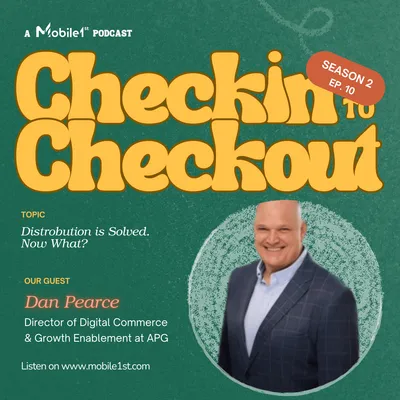
Distrobution is Solved. Now What? - Dan Pearce
Dan Pearce, CEO of Sovereign Naturals, has spent 30 years watching e-commerce evolve — and he's got a clear-eyed take on where most brands are getting left behind. In this episode, Dan breaks down why the distribution problem is solved, why demand capture is no longer enough, and what it actually takes to build a brand that creates demand from scratch. From TikTok affiliates to doctor interview series to rethinking what your DTC site is actually for, Dan lays out how he's rebuilding Sovereign Naturals' entire go-to-market approach — one snowball push at a time.
Want any help Personalizing Every Customer Touchpoint?
Check out https://Mobile1st.com
Interested in talking to Justin or getting on the show, find him on Linkedin: https://www.linkedin.com/in/justinaronstein/
Key Insights:
- Distribution is solved. Amazon did it. The new game is demand creation — and the brands that understand that are the ones growing.
- Demand capture was a straightforward business. Remove friction, capture intent. That era is over.
- Channel agnosticism is the right mindset. Consumers buy where they want. Your job is to make them want it, not steer them.
- Trust over transactions. If your CRM is 80% promotional, you're training customers to wait for a discount — not build a relationship.
- Discounting has diminishing returns. Run a sale twice, then four times, and you've trained your customer not to buy at full price.
- Storytelling at scale is the new performance marketing. Blogs, employee stories, doctor interviews, trade show video — all of it builds demand before someone ever searches for you.
- Hire experts and then actually let them expert. Bringing in talent and then telling them exactly what to do defeats the purpose.
- Minimum viable momentum beats swinging for 10x. Ask if you're better today than yesterday. That's the metric that compounds.
Transcript
Justin Aronstein: Welcome to Check In to Check Out. Today we have Dan Pearce, CEO at Sovereign Naturals. And we're really going to get into Amazon today. I'm really excited because it's actually a world that I haven't played in that much besides maybe hooking up some pipes. So Dan, you're CEO. What do you do every day? What's your day look like?
Dan Pearce: That certainly depends on the day. Ideally, I'm keeping our leadership team and organization focused on our strategic path and really trying to put people in the position to do so. I believe people want to do a good job. If we put them in a position to do so, we're usually going to be pretty excited by the results. On a good day, that's what I'm doing — making sure people have the clarity, the fit, the belief to execute extraordinarily well.
And that's interesting in these days, because I'm in a natural products company. We sell dietary supplements and what a good job looks like has changed dramatically over the last couple of years. Amazon started selling supplements 15, 18 years ago. Until then, it wasn't an option. And now that they've gotten there, we're even seeing changes there. When I came on board and asked my team where they thought our sales came from, we were disconnected. We're a company that grew up through mom and pop health food stores and they're incredibly important to us. But more of my business is digital right now than it is in those stores. So as CEO, a lot of the job is representing our customers and our consumers and making sure people are doing everything they can to make a great experience for them.
Justin Aronstein: One thing you said — the job has changed dramatically in the past three to four years. What about it? Why has it changed from your perspective?
Dan Pearce: I'm going to go back a little bit further than three or four years. I have a history degree, so sometimes I like to go way back on stuff. For the history of mankind, anyone who wanted to be in commerce was solving for distribution. The farmer needed to take his product to market. Then we expanded — the Silk Road, the British East India Trading Company, all those different things. Until about 20 years ago, that was always the solve. Walmart just opened more stores. That was the strategy. Brands tried to get into as many stores as possible.
And then this juggernaut named Amazon came along and solved distribution. I can get almost anything I want within a day. My wife called me last night and said she was out of a few things, but she was coming to see me tomorrow. Those products were waiting at my inbox this morning at 7am. Distribution is not a problem anymore.
So for a lot of brands, Amazon over the last 10, 15 years solved distribution and they grew because anyone who was interested in their product could purchase it. It was absolutely growth, but it wasn't growing demand. Now that that's saturated — and you see it in search traffic, whether it's on Google or Amazon — you have to start solving for creating demand. The brands that understand that are skyrocketing. The people who are just waiting for the next distribution network are struggling.
And then the next piece is that Amazon at its core is still just another retailer. They own the customer. They want to control that relationship and they're going to squeeze as much margin out of it as possible. That's what every retailer does. After a certain point, if you truly want to engage with your consumers, you need to do that directly. Amazon Seller Central gives you some of that. D2C can give you more. Engaging on social media can give you more.
Justin Aronstein: Totally. So demand creation is so important right now. But how does that change how you and your team spend your time? Where are you focusing to create demand?
Dan Pearce: The first thing to understand is that demand goes where demand wants to go. Ten years ago we were talking about this channel versus that channel. But consumers want to buy what they want, where they want, when they want. So it's all us together now.
Where I'm spending a significant amount of time is telling our story at scale. That's working with TikTok affiliates and making sure they represent us well, building an army of people who want to tell our story. That's being on Meta, both paid and organic, telling our story from different lenses. We have a million dollar electron microscope on campus to make sure our product meets our standards and a PhD on staff that does nothing else but research. Those are all great things, but it's only great if people know about it.
We essentially sell colloidal silver or copper — a very fine nanoparticle suspension in ultra pure water. We do it at a very high level, medical grade. We make and purify our own water. And we found that for a long time, even though we were already buying medical grade bottles, we were taking an extra step of washing them. One day our regulatory team came in and said, well, we're not sure we should still be washing the bottles. We could have said, let's just quietly stop. Instead we said: we spent a lot of time doing this because it was the best process. If it's no longer the best process, we'll walk away from that investment. It's the right thing to do. And that itself is a story that tells you something about us.
So it's getting our team to understand it's not just getting someone on TikTok to look at a product. It's not just running DSP on Amazon. It's blogging, sharing employee stories, interviewing people. For as many stores as our products are sold in, we're sold in that many doctors' offices. So we're setting up an interview series — not "how do you use Sovereign Silver in your clinical practice," but "tell us about your practice." That makes our world bigger and creates an opportunity to build demand down the line. It's not always the linear performance marketing. We can buy transactions, but we can't buy transactions where there isn't demand.
Justin Aronstein: I love that. And I think a lot of brands miss that.
Dan Pearce: Yeah. I think about it this way — I was driving to dinner with my wife. We were going to the Peruvian place by our house. We passed a great steak place, a great Chinese place, a great Italian place, and we didn't stop because we wanted Peruvian. If they didn't have a table, we would have gone to one of the others. That's kind of like targeting competitors on Amazon. If someone types in "I want to buy ABC vitamin," they wanted to buy ABC vitamin. Just because we believe our products are better doesn't mean we get to overwhelm their intent with our desire.
So what I'm constantly obsessing over with my team is: what's the next best dollar spent? Are we maximizing Amazon capacity? Great. Let's start shifting those dollars. Where do we shift them? It may be a blog, it may be an interview. The great thing about digital is we get to make those shifts a lot faster. In brick and mortar, I set an annual merchandising plan. On digital, we change budgets daily. And the Amazon team knows that if we're driving more demand, they'll capture more of it because I can't determine where the customer will buy. So it all works together.
Dan Pearce: Overall search traffic, overall intent, social media — we call it brand momentum. We're trying to build an internal index to say: are more people looking for our product and engaging with it than they were before? And that's across multiple platforms, multiple media, and it changes every day.
Jonathan Silverstein: You're an expert in the world of demand and distribution, but you've also only been at Sovereign Naturals for about four months. It sounds like you've been there for ten years. Talk to us about how the momentum is happening with the team. Are they reacting well? What are you seeing as far as culture changing?
Dan Pearce: I was lucky. I try to go places where the company has an authentic story that's real — we don't have to make it up. And when there's a good team in place, it makes my life a lot easier. We have a great team, more traditionally focused, but very eager to look in other directions.
We've augmented with contractors — people I've worked with in the past who can come in and bring outside perspective. When I was at NetRush and we had hundreds of brands, our Friday conversations about what we saw in the marketplace were incredibly rich. I try to maintain that by calling someone in digital every day just to ask: what are you seeing? And I've structured the team so that the person creating science content is different from the person working with Instagram influencers is different from the person working with TikTok affiliates.
Then it's getting people comfortable with measuring and adjusting, measuring and adjusting — as opposed to scripting. In dietary supplements, I can't say the product works. I'm barred from that. So what I'm solving for is making sure customers believe my product is safe. I'm willing to talk about bottle washing and medically purified water and things because it indicates safety. I'm willing to show that we have 45,000 4.7-star Amazon reviews. My team says, "Well, maybe they didn't buy on Amazon." No — that's just a measurement of safety for me.
Every story we tell has to hit one of three lenses: safety, efficacy, or helping people rule their health. At a recent trade show, we had a videographer in our booth and we were simply asking people: what do you do to rule your health? If they wanted to talk about a competitor, we didn't care, because we're celebrating the choice. The more people that choose to take control of their health, the better off we'll all be.
Justin Aronstein: So do you care what channel a customer buys from?
Dan Pearce: I refer to myself as channel agnostic. I've been doing this for over 30 years and I believe at my core that I'm in the business of improving people's lives. That means I don't try to steer people from one channel to another. I love great retail. I love a great website. I love a great online experience. But the consumer should buy where it's best for them.
I was at a trade show a couple of years ago and the CEO of Adidas said: "We don't own customers, we earn them." That always stuck with me. We sometimes talk about our consumer as someone we can steer and direct. As a consumer, that's the last thing I want. I love asking my team: would you want this done to you?
Jonathan Silverstein: What are you and your team focused on over the next six to twelve months?
Dan Pearce: The first one is measurement. Really understanding — and you can see your brick and mortar data, your Amazon data, your D2C data — but bringing it together in a view that says: are we growing the pie, or are we just moving the pie around? Most brands I've worked with will say this channel is up, this channel is down. But how are you in total?
At the same time, we're trying to start telling our story at scale because the only way you get to 100 videos a day is to get to one video a day, then two, then four. Build that momentum, push the snowball. I talk with my head of marketing, Nicole, every day about: did we build momentum?
The third part is figuring out what the biggest levers are so we can pull on them hard. Not pulling a whole bunch of levers, but saying: this is a place we're really effective, let's really dive in here. And then continuing to evaluate, because as much as we're talking about TikTok today, we'll be talking about something different next year.
And then the real shift is our DTC site was very promotion-driven. We're now making the switch to saying: when we email our customers through CRM, it's going to be information given — either information to use or to share. Building a relationship, not just a transaction. My comment to the team is: trust over transactions. If we're building trust, we'll be okay. If it's transactional, it's going to go away to the next best transaction.
Justin Aronstein: Dive into that more. What does building trust actually look like beyond email?
Dan Pearce: A lot of it is listening. My head of marketing is developing a new position focused on social listening and engagement. We were sitting in the office one day and I pulled up TikTok and I started searching and I said: guys, here are all the people already talking about us. How do we engage with them? They already love us. How do we tell their story?
I've always believed — and this came from when I was on the agency side asking brands at NetRush — what does your consumer get out of D2C? I want them to feel like they're in a club. I was at a brand called MegaFood for years and our CEO did a great job. We'd open up our facility a couple of days a year and have a festival around it — bringing in top retail customers and letting consumers from the area come and have raffles to visit. What we do is kind of magical. We kind of invented this process.
I'm bringing a videographer on staff, and one of the reasons is to start telling people that story. Our timeline on one of our gold products has been 14 years and counting. This is what it takes to make this product. And for those people who want to engage beyond just an affiliate doing a dance on TikTok — and that's great too, that's part of what we do — but engagement has to work across how people want to engage. I'm very comfortable on LinkedIn. I post less on Meta. That's nothing against Meta, it just isn't where I'm comfortable. Being able to engage across those channels matters.
Justin Aronstein: Most brands are 80% promotion, 20% story. I think it needs to be flipped to build that relationship and community. Because if you have a brand, people will be excited about it. I talk about Outdoor Voices all the time — there was real community there. We'd go on runs with that community. Half our wardrobe was Outdoor Voices. Then it got bought by P&G and that community went away.
Dan Pearce: Trying to build community online is different. That was the promise of social media and I'm not sure we've really achieved it yet. But those moments of community — I think it's Seth Godin who says tribes, "people like us act like this." I think there's a second sentence to that, which is: and it's cool if you don't too. It's not divisive.
Going back to your 80/20 — what's it in service of? Are you solving for a short-term pain point? Because the math is pretty simple: if you drop prices 20% and you don't increase volume 20%, you lost sales. I remember a brick and mortar chain that used to run a one-day sale once a year. Incredible spike. So naturally they ran it twice. Then four times a year. And by then they had trained the customers to dip in sales before the event and spike on the day. It went from something I loved supporting to something like: why don't you support it as much anymore? Because you trained people to only buy on that day, at that price.
There's nothing wrong with giving people value. But it's more important to accomplish more of what you set out to do, not just accomplish it once and move on.
Justin Aronstein: So what is your e-commerce hot take?
Dan Pearce: The question I ask people invariably is: what are you solving for? Is it demand or distribution? Because if you don't know that, you don't have a lens to know if you're making a good decision or not.
Should I do DSP on Amazon? What are you solving for? I own 70% of my category. I've done a pretty good job of capturing demand. So my dollars are starting to transition to generating demand. When I was on the agency side, that question did not get answered nearly enough. And I think if you're in Justin's shoes, if you're in Jonathan's shoes, and the client doesn't know that, I don't know how they understand your advice. Why is he telling me to spend more money? A lot of brands see e-commerce spend as trade spend — it's just the cost of being on shelf. That's solving for distribution. Demand spend is measured differently. It occurs in different places.
My hot take: understand what you're solving for first. If you don't have distribution, go capture it. That's going to be a fun ride for a while. Once you get there, what got you there is not going to get you to what's next. The people who are getting that are growing exponentially even in a tough economy. The people who are struggling are going to continue to struggle.
Jonathan Silverstein: Is there a piece of the business that you dread?
Dan Pearce: I hate the conversations about "this is what we've always done, so how are we going to keep doing it and get different results." The business insanity question. Or "how are we going to protect this part of the business?" No — how are we going to unleash this part of the business? If I'm generating demand, my core traditional business is going to grow. My core retailers that supported us early on are going to benefit from me increasing demand. Protecting them does not help them.
And I'll admit — none of the things I'm talking about am I an expert in. It's been 10 years since I've touched an Amazon Seller Central console. When I was at NetRush, there was no way I was touching that and risking turning something off. There were people who were really good at it. They weren't me. I trust my TikTok team. Becca runs that for me and she lives in that world. On the content side, I ask Tom what he's doing. Nicole and Stephanie handle branding. Angel runs my Amazon business.
We need to embrace hiring experts and then actually letting them expert. Because you can't learn this stuff fast enough. And when you get below that line and you think, I'm going to go learn TikTok — no. Call the person who knows TikTok. But also hold on, because some of what they'll say is going to make you say: wait, you said what? Explain that one a little better. Seeking to understand becomes critical. And if people don't get that 80/20 flip, it's going to be really hard to deliver results. And that's bad for both sides.
Justin Aronstein: The demand generation versus demand capture framing is really interesting in our world of onsite optimization. The old world of demand capture was: reduce friction because the demand is already there. But we're out of that world. Now you actually have to create an emotion, create a community, create a reason that someone wants to interact with you beyond just having the demand already. And that's where the on-site story has to be told.
Dan Pearce: Absolutely. Demand capture was a pretty straightforward business. Remove friction. Now it's multi-layered. How are you building community at scale? How are you telling a story at scale? And how are you navigating the fact that a company may not be structured to support that yet?
Dan Pearce: The pace is happening correctly, I think — building momentum every day. It's not happening at the pace that I want, which is my problem, not everyone else's. I can't come from digital, see where it's going, and expect everyone else to already be there. So I keep coming back to minimum viable momentum: can we just be a little bit better today?
When I came on board, we were just getting ready to re-launch organic social after having shut it off for good reasons. And we just said: let's get a post live. We didn't like that one? That's okay. We'll get another one. Now I'm asking the team: how do we double our output? Don't solve for 10x. Just double. When we've done that, we'll ask the same question again. If you don't take the first step, you don't get anywhere.
I always challenge my team to try to be lazy — in a good way. I did jiu-jitsu for 20 years. When I was a black belt going on Saturdays, I could train two and a half hours straight with whoever wanted to go because I was only doing the things I thought were going to work. That's the advantage of being an expert: you're not wasting energy on moves that won't land. I'm trying to apply that here. What gets us to the next hump? Let's build from there, as opposed to trying to do everything at once. I talk to my head of marketing every morning. We check: how many people viewed us, how many bought. Was the number bigger today than yesterday? Yep. That's a win. Let's go.
Justin Aronstein: What are you reading, listening to, what's interesting to you right now?
Dan Pearce: I'm an Audible junkie. This week I re-listened to the big three Dan Sullivan and Ben Hardy books — Gap to Gain, Who Not How, and 10x Is Easier Than 2x. All popular around our office, but great reminders. On fiction, I love Daniel Silva and re-read his books almost every year — my wife is Italian, so he does a lot in Italy which gives us something to talk about. And then podcasts have taken a back seat lately because I've been listening to books, but those are the big ones.
Justin Aronstein: Awesome. Thank you so much for your time, Dan. These were amazing insights. Really appreciate it.
Dan Pearce: Thank you guys so much for having me. Keep up the great content — I love what you guys put out there.