
The Higher the Price, the Longer the Relationship
There’s a direct relationship between how expensive your product is and how long it takes someone to buy it. The higher the price, the more your customers need to hear about your brand, understand your product, and build enough confidence to actually click “buy.” The number of interactions needed to make that happen grows exponentially as price goes up.
That’s why impulse purchases live under $27, while the stuff that costs hundreds, or thousands, requires time, repetition, and reassurance. Nobody wakes up and decides to drop $1,200 on a single piece of outdoor gear or a $4,000 espresso machine. They need to learn their way into trust.
This is true everywhere. It’s why IBM sponsors every major sporting event under the sun. When a decision-maker is watching the US Open, sees IBM plastered on the scoreboard, and thinks, “Oh yeah, I liked that demo last week, I need to follow up with the sales rep,” that’s not an accident. That’s repetition doing its job. IBM knows that closing a $4.5 million consulting deal doesn’t happen after one cold email. It happens because the buyer feels surrounded by the brand, seeing it over and over again in contexts that make them feel confident it’s a safe, smart choice.
Now, that’s an extreme example. But the same principle applies whether you’re selling enterprise software or a $300 aftermarket radiator. The psychology doesn’t change, only the scale does.
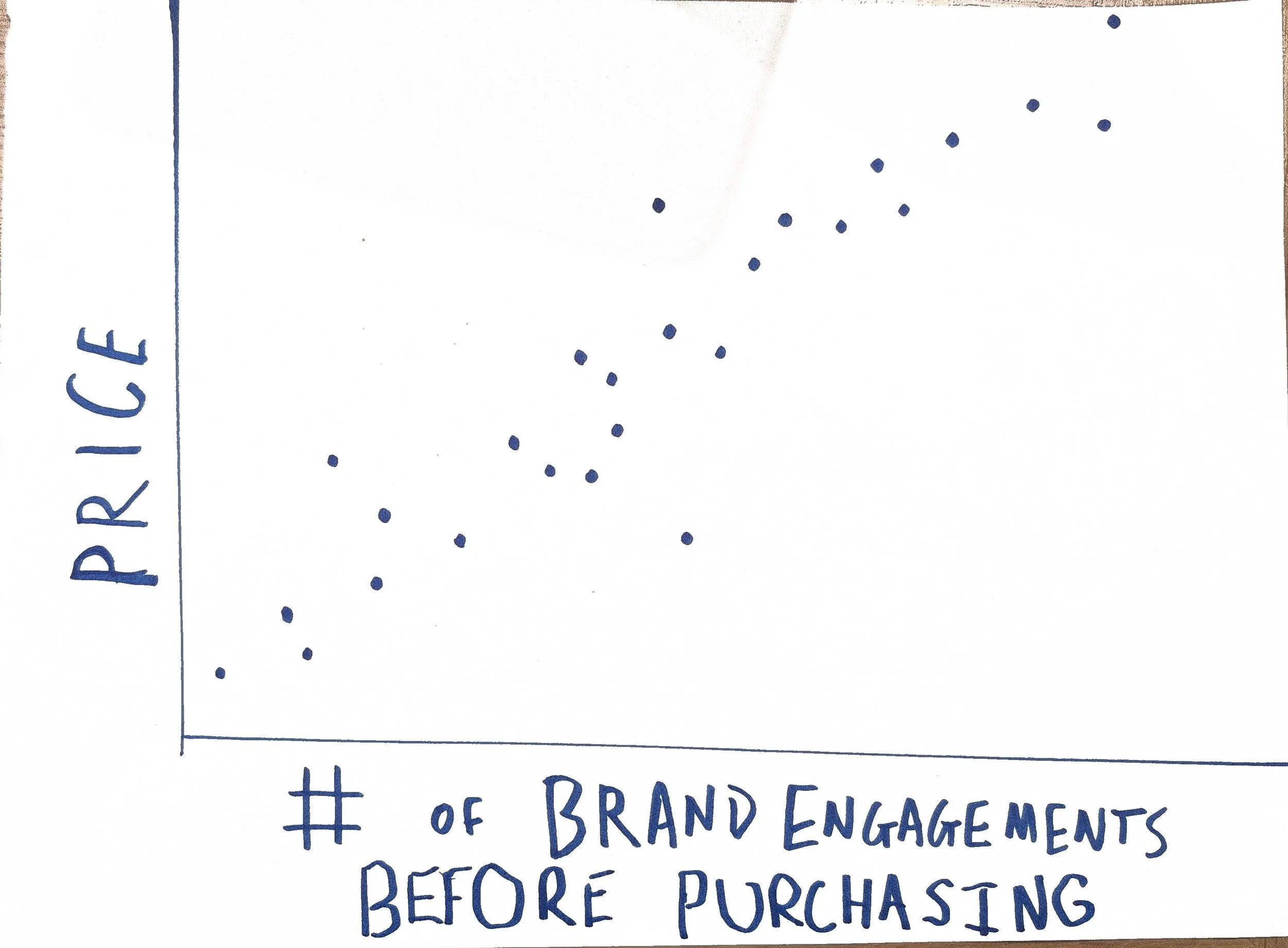
The more expensive your product is, the more times someone will have to engage with your brand before they make a purchase.
The Real Customer Journey (It’s Not Linear)
Let’s say you’re that automotive brand selling radiators. You think you’re optimizing for a clean funnel. Someone sees your ad, visits your site, and buys. Simple, right? Except that’s not how anyone actually buys anything expensive.
Here’s what’s really happening:
A customer first hears about you from a friend who installed your brand’s radiator last year. They make a mental note. A few days later, they’re scrolling and see your brand again on a Reddit post. Now they’re curious. They Google you, land on your site, skim the product detail page, and think, “Cool, looks legit.” Then they get distracted and go back to whatever they were doing.
A week later, your retargeting ad catches them mid-scroll on Instagram. They click again, but this time they’re looking for more detail: technical specs, installation instructions, anything that helps them feel confident it will fit their car. They’re not ready to buy; they’re researching.
Then they head to YouTube to find installation videos. Maybe you have one, maybe it’s someone else’s. Either way, your brand name gets mentioned. They watch it, learn more, and head back to your site to confirm what they just saw. Then they text the link to a friend to double-check they’re choosing the right part number.
They do this over and over again for three weeks. Nine site visits. Three devices. A mix of search, social, and text messages. Finally, they decide: once the next paycheck hits, they’re buying it.
Friday night rolls around. They’re watching TV, beer in hand, looking at your site again, but the Spurs take the lead in the 4th, so they put the phone down. Go Wemby! Saturday morning, they pop the hood on the car, confirm the fittings look right, and finally, finally buy.
Twenty total brand touchpoints, four conversations with friends, and three conversations with themselves, they finally pull the trigger. And a journey your analytics platform has almost no chance of stitching together into a single “session.”
What This Means for Your Site
First, your conversion rate probably isn’t as bad as you think it is. People aren’t dropping off because your site is bad; they’re leaving because they’re doing research on other devices, at different times, in different moods. Most attribution systems treat that like a loss, when in reality, it’s progress.
Second, and more importantly, your site needs to do more than just sell. It needs to educate, reassure, and remind. The more expensive your product, the more your website has to act as both a salesperson and a teacher.
Your homepage may never even enter the equation. The product detail page is where almost all of this needs to happen. But it’s not just about “reducing friction” or getting someone to find the buy button faster. It’s about making sure they can find every single piece of information they might need, no matter where they are in their journey.
That means:
Technical details that are complete, accurate, and easy to find.
Photos that show real-world use, not just perfect lighting.
Installation guides or links to relevant content.
Reviews that actually talk about performance and longevity, not just shipping times.
And maybe most importantly, content that connects your product to the real-world problems it solves.
If you’re investing in great content for TikTok, Instagram, or YouTube that explains how good your product is, make sure those videos are accessible from your product pages. A customer who finds you through social isn’t necessarily ready to buy there, but once they land on your site again, that content can close the loop.
Lastly, if you’re measuring experiments, use revenue per visitor as your key metric. While you’re not going to be able to stitch every touchpoint together, if you can at least prove your change increases revenue across all of the visitors, even those that came back multiple times, it will be a better predictor of long-term growth.
Should You Personalize Your Site Based on Where They Are in the Funnel?
Yes, absolutely. As long as you’re personalizing for every part of the funnel.
The hard part is understanding the intent signals to know where someone is in the funnel. But let’s say you know that, now you need to provide the relevant content. To do that, you already need to have the content produced and accessible on the PDP. So before you start personalizing, ensure that you have created and organized content for all parts of the funnel on the PDP.
And then once you start personalizing, please, for the love of God, don’t just give discounts to people who show intent signals that they’re ready to buy. That’s just throwing away gross margin. Instead, focus on increasing value through your use of USPs, and shipping and returns messaging.
The Real Job of a Product Page
No matter how expensive your product is, your job isn’t to make the site “convert faster.” It’s to make it easier for someone to stay confident across all those interactions that happen before the sale.
When people are looking at your product page, they’re trying to get 7 things done… It’s hard to tell which one until they engaging with the page, so make it easy to do any of these tasks.
That’s a subtle but critical shift. It’s not just about optimizing checkout or tweaking buttons. It’s about designing your site to support every part of a nonlinear journey that could stretch across six weeks, multiple devices, and countless distractions.
Because people don’t buy products fast. They buy them when they’re ready; after they’ve been convinced, reassured, and reminded. Your site just needs to be there every time they come back, ready to help them take the next step in their decision.
Disagree with something? Send me an email and let me know.
Want more?
Make your job easier, let Mobile1st Grow RPV for you
At Mobile1st, we help e-commerce brands grow revenue per visitor.
We do it by combining customer-first research with testing and experimentation that cuts through the noise of dashboards and opinions. Our team uncovers what really drives purchase decisions, then runs experiments to prove impact — so you can stop guessing and start scaling
Want help? Reach out.
Want to be featured on Checkin to Checkout?
Send an email to justin@mobile1st.com, and we’ll set up a time to get to know you to see if you’re a great fit. We’re always looking for e-commerce leaders to feature on Checkin to Checkout
