
This Week on Checkin to Checkout
 This week on Checkin to Checkout, Doug Villella from APG breaks down what it actually looks like to build an e-commerce operation from scratch inside a company that sells O rings — and why talking to customers every week is the only strategy that matters.
A note from me: We've been quietly rebuilding Mobile1st.com behind the scenes, with the goal of better expressing what we do. I'd love for you to check it out and tell me what you think. And over the next few weeks you'll start to notice some small changes to how this newsletter is structured. Same content, better delivery.
Here's the uncomfortable truth most agencies won't tell you:
Your Shopify template is fine.
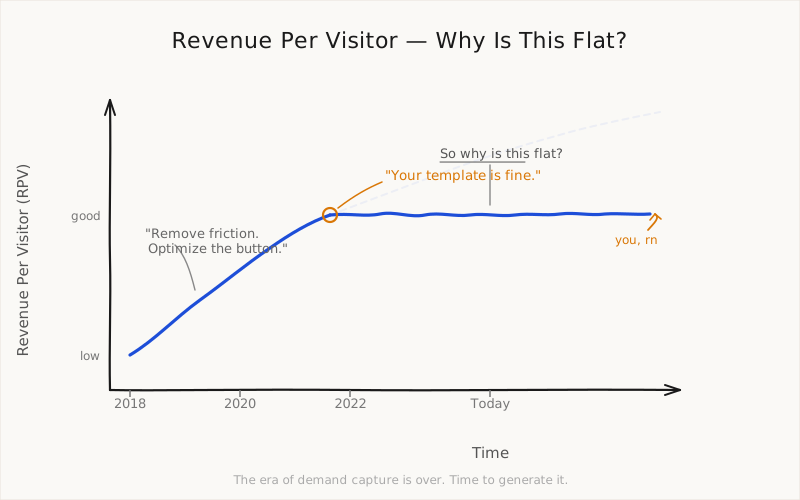
Friction isn't actually the problem. You've already fixed that. The buttons are big. The checkout is fast. The mobile experience is clean enough.
So why is revenue per visitor still flat?
Because we left the era of demand capture. Every tweak you made to reduce friction was demand capture logic. Assume the customer wants to buy, remove the obstacles, collect the money.
That era is over.
We're now in the era of demand generation. And that requires something completely different. It requires making someone feel something about your brand before they've decided to buy.
That's emotional connection. And you build it through storytelling and through personalization. We wrote about the four conversion killers most brands ignore — this shift from demand capture to demand generation is at the root of all four.
Talking to your customer based on what they've told you about themselves, or what they've responded to in the past, is the highest-leverage move left in e-commerce. It's the difference between a catalog and a conversation.
Before we get into the tactics, there's something we need to address. None of this works without the foundation underneath it.
The Prerequisite: Your Data Has to Be Clean
Personalization is only as good as the data powering it.
Most brands skip this conversation entirely. They hear "personalization" and immediately start thinking about tools and tactics. Then they implement something, it underperforms, and they blame the tactic. The real problem was upstream the whole time.
Here's what you actually need before any of this is worth building:
UTM hygiene. If your ad campaigns aren't properly tagged, you can't match landing pages to ad creative. You can't attribute traffic to the right source. You're flying blind and calling it personalization.
A consistent customer identity layer. Shopify gives you a customer ID. But are you connecting it to your email platform? Your ad platform? Your on-site behavior data? If those systems don't talk to each other, you have islands of data instead of a picture of a person.
Klaviyo (or equivalent) as your single source of truth. The affinity data, quiz answers, browsing behavior, purchase history. It's only useful if it lives somewhere central and feeds back into every touchpoint. For most Shopify brands, that's Klaviyo. Not because it's the only option, but because it sits at the intersection of on-site data, email, and SMS in a way that actually works.
You don't need a full CDP to get started. But you do need clean UTMs, a connected email platform, and some agreement about where customer data lives. Without that, the tactics below are mostly theoretical.
Get the foundation right. Then build on it.
1. Treat New Visitors and Returning Visitors Completely Differently
This is the most underused personalization lever in e-commerce. It requires almost no data infrastructure. And almost nobody is doing it.
A first-time visitor and a returning visitor have completely different jobs to be done.
The first-time visitor is asking: Can I trust this brand? Is this product actually for me? Why should I buy this instead of something else? They need education. They need social proof. They need the brand story up front.
The returning visitor is asking: Where was I? Did anything change? Give me a reason to finish. They don't need the origin story again. They need to pick up where they left off.
When you serve both visitors the exact same homepage, you're failing both of them. The returning visitor is bored by the intro. The new visitor is overwhelmed by the assumption that they already care.
The fix is straightforward. Detect the visit number and adjust the experience accordingly. For new visitors, lead with trust signals, brand story, and orientation. For returning visitors, surface recently viewed products, pick-up-where-you-left-off messaging, and anything new since their last visit.
It's not complicated. It's just not the default. And that gap is your opportunity.
2. Match the Landing Page to the Ad They Clicked
You probably have 400 social ads running right now.
5 personas. 10 emotional angles. 15 different messages about why someone should care about your product.
And every single one of those ads sends the customer to... the same homepage. The same generic PDP. The same collection page that knows nothing about why they clicked.
The ad said: "Finally, a solution for X." The landing page says: "Welcome. Here are our products."
That's a broken handoff. And it's costing you conversions every single day.
The fix is simple in theory. You match the landing page experience to the ad. If the ad spoke to a specific desire, the landing page leads with that desire. If it featured a specific product angle, the page opens with that angle.
We have a software-assisted solution that does this at scale, even when you're running hundreds of ad variants. Every landing page experience matches the ad that drove the click. The handoff becomes seamless. The story continues.
It works. And it's more fun to build than you'd think.
3. Give Google Shopping Visitors More Than Just the One Product
Someone clicks your Google Shopping ad. They land on the PDP.
Cool. But here's the problem: that might not be the exact product they actually want. It might be close. It might be in the right category. But now they have to go back to Google Shopping, scroll around, hope your other ad shows up, and maybe click through again.
You just paid for that click. And you're sending them back to Google to try again.
The better play? Show them the product they clicked on AND a curated set of similar products right there on the page. Let them find the right fit without leaving your site.
Wayfair does this. Yeti does this. 1-800-Flowers does this.
They turn a single ad click into a discovery experience. The customer doesn't need to go back to Google because everything they need is already in front of them.
This is solvable. If you're sending Shopping traffic to a vanilla PDP and nothing else, you're leaving money on the table every hour of every day.
4. Change the Site Based on What the User Has Shown You
Every time someone visits a product page, applies a filter, or makes a purchase, they're telling you something.
After 2 or 3 visits, you can start to see patterns. They keep looking at a specific brand. They always filter by a specific category. They haven't bought yet, but they're clearly interested in a particular corner of your catalog.
That's affinity data. And most brands just... ignore it.
The smarter play: use it.
Sort category and search results based on the brands and categories they've shown interest in. Add a "Popular in [Category]" section to the homepage that dynamically reflects their affinities, not the site's overall bestsellers. When they come back after a few days, show them recently viewed products right on the homepage instead of making them go find what they were looking at.
This is especially powerful if you have a large catalog. A customer who comes back to your 10,000-SKU site shouldn't have to start from scratch every time. The site should already know where to start the conversation.
You've already collected the data. Now use it.
5. Just Ask Them What They're Looking For
People want help finding the right product. Most brands just never ask.
Buff City Soap is the best example I've seen of this done right. They have a quiz that isn't a sidebar widget or a popup. It's genuinely part of the experience. It asks a few questions. It learns what you like, what you're trying to solve for, what your preferences are.
And then every interaction going forward is shaped by those answers. The product recommendations. The emails. The next time you visit the site.
It's like walking into a specialty shop and having the owner ask you four questions before pointing you toward anything. That's a white glove experience. And it makes the sale feel obvious instead of effortful.
If you have a catalog with any real complexity, multiple use cases, multiple customer types, multiple problems you solve, a quiz is one of the highest-ROI things you can build. Not because it reduces friction. Because it builds connection.
6. Let Email and SMS Finish What Your Site Started
This one gets left out of almost every personalization conversation because it lives "off-site." That's exactly why it's a blind spot.
Everything on-site, the quiz answers, the affinity signals, the browsing behavior, the recently viewed products, has a second life in your email and SMS flows. But only if you've connected the systems.
Think about what's possible when you do:
A customer takes the quiz and doesn't buy. Your email flow picks up exactly where they left off, leading with the product the quiz recommended, not a generic welcome sequence. A customer browses a specific category three times but never adds to cart. Your SMS fires at the right moment with the right product, not a 15% off coupon that trains them to wait for discounts.
The on-site experience plants the seed. Email and SMS water it.
Most brands treat these as separate programs. The ones winning right now treat them as one connected system. The quiz answer that lives in Klaviyo should shape every email that customer ever receives. The affinity data from their browsing should inform which SMS campaigns they're enrolled in.
On-site personalization without the off-site follow-through is a leaky bucket. You're doing the hard work of learning about the customer and then forgetting everything the moment they leave.
Don't let the data go to waste.
7. Use AI, But Not an Open Chatbot
Yes, AI. Obviously.
But not the way most brands are implementing it.
An open chatbot sitting in the corner of your site is not personalization. It's a support ticket waiting to happen. Nobody wants to type a question into a box and wait for a response.
What actually works is a guided tool. Something that proactively helps customers figure out if a product is right for them. Not a general-purpose assistant. A purpose-built experience that walks someone through the right questions and surfaces the right product for their specific situation.
Done right, this increases conversion rate. Not because it removes friction. Because it builds confidence. The customer leaves the interaction knowing they made the right choice, which means they're far less likely to return it and far more likely to come back.
The tool does the work of a great salesperson. And unlike a great salesperson, it scales.
The Through-Line
Notice what none of these have in common with the old playbook.
None of them are about removing friction. None of them are about faster load times or cleaner checkouts or bigger "Add to Cart" buttons.
They're all about creating demand. About making a shopper feel seen, understood, and guided before they've decided to buy.
That's the era we're in now.
The brands that figure this out first are going to pull away. The brands still optimizing button placement are going to wonder why their revenue per visitor keeps flatlining.
Personalization isn't a feature. It's the strategy.