
The Great E-Commerce Hypocrisy: Why You Treat Your Ads Like Science and Your Site Like a Guessing Game
I know what your week looks like.
You are absolutely grinding on customer acquisition. You are feeding the beast. Your creative team is sweating bullets, churning out video assets, static images, and carousel copy faster than a fast-fashion supply chain.
Why? Because you have to.
Ad fatigue is real. Creative burns out in days, sometimes hours. Facebook and Google’s algorithms are hungry little monsters that demand fresh meat constantly to keep your CAC (Customer Acquisition Cost) from skyrocketing into the stratosphere.
You are obsessively testing. You’re throwing spaghetti at the wall to see what the algorithm catches. You trust the machine. When the dashboard says "Ad A is a winner," you don't argue. You double down. You scale the spend. You high-five the media buyer.
But then... that expensive, hard-won traffic hits your website.
And you treat your website like a museum exhibit while treating your ads like a high-frequency trading floor. It’s the single biggest hypocrisy in e-commerce right now, and honestly? It’s costing you a fortune.
The "Clean Data" Trap (Or, Why You Trust Zuck More Than Your Own Eyes)
Here is the uncomfortable truth: You trust Facebook and Google because they have better marketing than your analytics team.
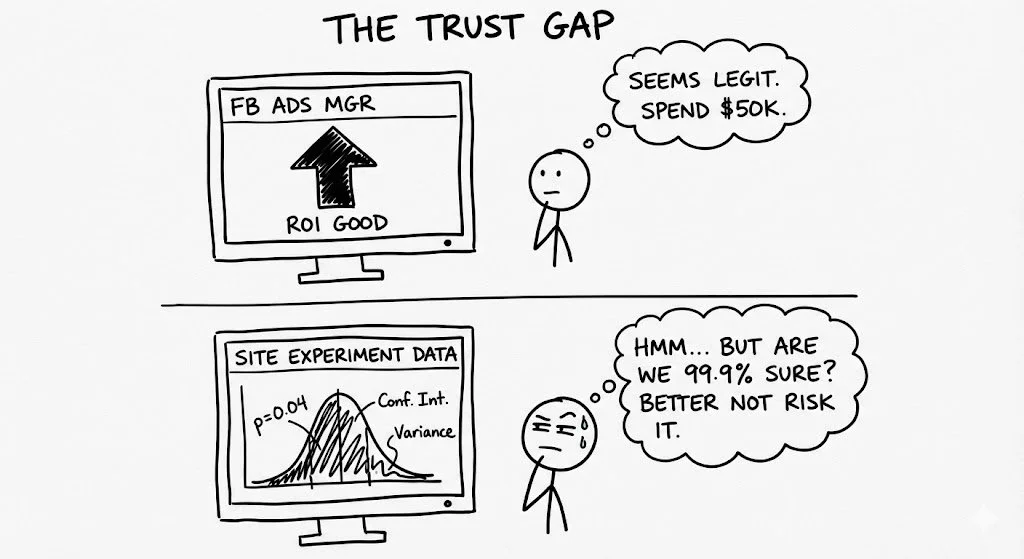
When you look at Ads Manager, they’ve stripped away all the nuance. They don’t show you confidence intervals. They don’t bore you with p-values or standard deviations. They give you a shiny green arrow that says "ROI GOOD." It looks unquestionable. It looks like absolute truth.
So you act on it immediately.
But when it comes to your own site—the place where the actual transaction happens—you suddenly turn into a skeptical academic from the 1950s.
If someone suggests changing the "Add to Cart" flow or testing a new value prop on the PDP, you freeze. "Is it statistically significant?" "Are we 99% sure?" "What if we break the brand aesthetic?"
Or worse, you fall back on the HiPPO method: The Highest Paid Person’s Opinion. You make changes willy-nilly because the CEO didn't like the shade of blue, or because a competitor did something cool last week.
You demand 99% statistical certainty to change a button on your site, but you’ll let Facebook spend $50k on an audience segment based on a "learning phase" algorithm you can’t even see.
Make it make sense.
One Size Fits... Nobody
Think about this: You are paying specifically to target distinct audiences. You have creative for the bargain hunters, creative for the luxury buyers, and creative for the impulse shoppers.
Facebook has done the heavy lifting to find these specific people.
And then you drop them all onto the exact same website.
Why is your site a static monolith when your acquisition strategy is dynamic and fluid? If you wouldn’t run the same ad to every single person on the internet, why are you showing the same homepage to every single visitor?
Okay, So How Do We Fix This Mess?
Stop treating your site like a sacred cow. It’s a product. It needs to grow. We call this Digital Product Growth.
If you want to stop lighting ad spend on fire, you need to apply the same rigor to the post-click experience that you apply to the pre-click experience. But—and this is key—you have to stop guessing.
To actually move the needle on Revenue Per Visitor (RPV), you need to know what matters.
Don't start with the homepage. (Seriously, stop it. That’s vanity.)
Dig into the data. Where are they dropping off?
Talk to your customers. There is a mountain of evidence regarding what your shoppers actually care about, but you’re ignoring it because it’s harder to find than a CPM metric.
Conduct user research. You need to identify what motivates your buyer, and what other options they have. Watch people struggle to understand why they should buy from you, and why they need to buy from you now. It's painful to watch, but it's the only way to learn.
The "Oh Crap, That Sounds Expensive" Part
I can hear your brain spinning already. "This sounds great, but I’m already stretched thin."
You’re right. Doing this properly isn't a side hustle for your marketing intern. To run a legitimate experimentation program that actually drives revenue, you typically need a "pod."
A Product Manager to own the roadmap and the research.
A Designer to build the variants so they don't look like trash.
A Developer to code the tests without breaking the checkout.
A Data Analyst to tell you if you actually made money or just noise.
If you are doing over $100 Million in online revenue, stop reading this and go hire that team immediately. They will pay for themselves in six months. Seriously, go do it.
But if you are in that $3M to $100M range? That headcount is a killer. You’re looking at $500k+ in salaries just to get started. That’s a tough pill to swallow when you’re trying to keep margins healthy.
There Is a Better Way
This is exactly why Mobile1st exists.
We don’t just "do CRO." We act as your Digital Product Growth partner. For less than the cost of one mid-level employee, you get the whole squad: PM, strategy, design, dev, user research, and analysis.
We own the Revenue Per Visitor metric. We do the research. We find what motivates buyers. We build the tests. We tell you what won.
Our clients like to say, "You guys just do the things that make the money."
It’s not rocket science, but it requires focus, expertise, and a refusal to rely on the HiPPO.
The Bottom Line
You are fighting a war on CAC with one hand tied behind your back.
If you’re going to obsess over new creative to decrease your acquisition costs, you owe it to your business to obsess over new site experiences to increase your revenue per visitor.
Stop letting your ads write checks your website can’t cash.
How we can help you right now
Does your site feel like a leaky bucket?
If you want to see exactly how much money you're leaving on the table, we can calculate that for you.
Want more?
Make your job easier, let Mobile1st Grow RPV for you
At Mobile1st, we help e-commerce brands grow revenue per visitor.
We do it by combining customer-first research with testing and experimentation that cuts through the noise of dashboards and opinions. Our team uncovers what really drives purchase decisions, then runs experiments to prove impact — so you can stop guessing and start scaling
Want help? Reach out.

Building a Golf Community through E-commerce with Jonah Redel-Traub
Listen to our latest episode of Checkin to Checkout which was recorded live in NYC.
